CNC material selection guide
Cast Aluminum vs. Cast Iron for CNC: How to Choose
Material and RFQ notes from our CNC process team—cast blank review and finish-machining planning.
Cast aluminum and cast iron can both be machined into accurate, useful components—but they solve different engineering problems. We compare weight, strength, stiffness, heat behavior, corrosion, machinability, and lifecycle cost to help you choose a material and casting route that fit your part.
Key Takeaways
Start with the trade-off
Cast aluminum is much lighter and typically transfers heat efficiently. Cast iron is heavier and generally stiffer, while gray iron is especially valued for vibration damping.
Fit the part, not just the material name
Loads, operating conditions, geometry, tolerances, production volume, and lifecycle cost all influence the right choice. A material that looks ideal on a datasheet may not suit the actual duty cycle.
The grade matters
A356 and A380 cast aluminum are not interchangeable, and gray, ductile, and compacted graphite iron behave differently. Confirm the specific grade, condition, and casting route. Further process detail lives under CNC milling for housings and plates.
Casting quality affects the machined result
Porosity, inclusions, uneven stock, and heat treatment can affect machining, finish, and dimensional stability. Define quality and inspection requirements before production.
Shop context
Cast aluminum vs cast iron on the RFQ
- Cast aluminum machines faster and lighter; cast iron damps vibration and often holds wear surfaces better—tell us the duty cycle, not just the alloy name.
- Porosity, skin, and hard spots in castings change feeds and scrap risk; note whether the blank is as-cast, rough-machined, or stress-relieved.
- We quote from the casting drawing plus finish stock allowances so milling/turning plans match the real blank, not a wrought bar assumption. No MOQ for prototype or production lots.
RFQ fields that change the quote
| RFQ field | What to send |
|---|---|
| Duty cycle / loads | Weight vs stiffness vs wear vs temperature priorities—not only the alloy name. |
| Blank condition | As-cast, rough-machined, stress-relieved; casting process if known. |
| Machining stock | Finish allowances on sealing faces, bearing bores, and datums. |
| Critical surfaces | Mark porosity-sensitive or cosmetic faces; hardness band if specified. |
| Acceptance | Dimensional / geometric callouts, surface finish, and any documentation scope (ISO 9001 / 13485 / AS9100D as applicable). |
What Are Cast Aluminum and Cast Iron?
Cast aluminum and cast iron are families of alloys poured or otherwise formed as castings, often into a near-net shape, then machined to create accurate datums, bores, threads, sealing faces, and other functional features. The casting route and the machining plan work together: a near-net casting can reduce material removal, but critical features still need suitable machining stock and stable locating surfaces.
They should not be confused with wrought aluminum products such as plate, bar, or extrusion. Wrought alloys are mechanically worked after solidification and can have different properties and structure. Cast iron is also distinct from steel: its carbon content and graphite structure give it behavior that differs from many iron and steel grades. For CNC selection, we start with the specified alloy or iron grade—not the broad label alone.
Common Cast Aluminum Alloys
A356 and A380 are two commonly encountered cast aluminum alloys. A356 is used in a range of cast components and may be heat treated, with the final properties depending on the casting quality and temper. A380 is widely associated with die-cast parts. Their strength, corrosion behavior, machinability, and suitability for a particular casting process differ, so the alloy should be selected around the design requirements rather than chosen by name recognition.
Engineering note
When reviewing a cast aluminum specification, confirm alloy, temper or heat-treatment condition, casting method, corrosion exposure, and which surfaces or features will be machined. These details can affect performance and process planning.
Common Cast Iron Types
Gray iron contains flake graphite and is commonly selected for its damping and machinability. Ductile iron has spheroidal graphite, which generally supports greater strength and toughness than gray iron. Compacted graphite iron has graphite with an intermediate, vermicular form and is used where a balance of properties is required. Because graphite morphology changes strength, toughness, vibration response, and cutting behavior, a grade-level comparison is more useful than treating all cast iron as one material.
Cast grades we see most often on CNC RFQs
Buyers rarely send a family name alone. These grade notes focus on machining and blank condition—not a substitute for the casting specification.
| Grade family | Typical CNC use | Shop / RFQ note |
|---|---|---|
| A356 (Al-Si-Mg cast) | Structural housings, brackets, heat-treatable cast blanks | Confirm temper (e.g. T6) and which faces are machined after cast; porosity near seal/bearing bores matters. |
| A380 (Al-Si-Cu die cast) | Die-cast covers, thin-wall housings | Often as-cast envelopes; plan stock on sealing faces and watch hard spots / skin. |
| Gray iron (flake graphite) | Machine bases, pump bodies, damped frames | Good damping and machinability; manage dust and abrasive constituents in the cut. |
| Ductile iron (spheroidal graphite) | Higher-load housings, wear-critical iron parts | Stronger/tougher than gray iron; still treat as a casting blank—allowance and hardness band belong on the RFQ. |
Grade names alone do not replace duty-cycle and blank-condition details. For casting dimensional and machining-allowance language, see ISO 8062-3; for A356 property bands, see a catalog sheet such as MatWeb A356.0.
Cast Aluminum vs. Cast Iron: CNC-Relevant Comparison
The figures below are broad, representative ranges for common cast material families, not design allowables. Exact values vary with alloy or grade, casting process, section size, heat treatment, and test method. Use the supplier’s certified material data and the applicable design standard for engineering calculations.
| Property | Cast aluminum | Cast iron | CNC project implication |
|---|---|---|---|
| Density | About 2.6–2.8 g/cm³ for common casting alloys | About 6.8–7.3 g/cm³ for common grades | Aluminum can substantially reduce component mass and shipping load. |
| Strength | Varies widely by alloy and temper; many common cast alloys fall around 150–300 MPa tensile strength | Gray iron grades often around 150–300 MPa; ductile grades can be substantially higher, commonly around 350–700 MPa | Compare the specified grade and loading mode, not family-level values alone. |
| Elastic stiffness | Typically about 68–73 GPa | Often roughly 100–170 GPa, depending on grade and structure | Iron is generally stiffer by volume; geometry and support conditions still matter. |
| Thermal behavior | Usually high thermal conductivity; common casting alloys have lower service-temperature capability than cast iron | Lower conductivity in many grades; generally tolerates higher temperatures than common cast aluminum alloys | Account for heat flow, temperature gradients, expansion, and operating temperature. |
| Corrosion resistance | Forms a protective oxide layer; exposure and alloy still matter | Can rust in moisture or corrosive environments without suitable protection | Select a finish and maintenance plan for the actual environment. |
| Machining behavior | Often cuts readily; alloy and casting condition influence chip formation and finish | Machinability varies by graphite form and grade; dust and abrasive constituents may affect tooling and cleanup | Tooling, parameters, extraction, fixturing, and casting quality need to suit the material. |
| Typical applications | Lightweight housings, transport parts, and heat-transfer components | Machine structures, pump bodies, engine parts, and heavy-duty housings | Match examples to the part’s duty cycle, blank condition, and critical machined faces. |
Weight, Strength, and Stiffness
Cast aluminum’s density is roughly one-third that of cast iron, which can make a major difference for moving assemblies, transport equipment, and parts that must be handled or shipped frequently. Cast iron’s higher elastic modulus means it generally deflects less than aluminum for the same shape and loading, but the result depends on section geometry, supports, and the load path.
A higher strength value alone does not tell us whether a part is better. Strength-to-weight ratio, stiffness, fatigue or impact loading, wall thickness, and design safety factors all matter. A lighter aluminum component may need deeper ribs or thicker sections to meet a stiffness target; a well-designed iron casting may provide rigidity and mass that are useful rather than wasteful.
Thermal Conductivity and Operating Temperature
Cast aluminum generally conducts heat more readily than cast iron, which can help spread heat away from a localized source. Its high specific heat per unit mass also affects how quickly a part warms or cools. Cast iron is denser, so its heat capacity per unit volume can be substantial even though its thermal conductivity is commonly lower. The practical result depends on part mass, shape, airflow, contact surfaces, and heat input.
In CNC cutting, heat is shared among the tool, chip, coolant, and workpiece. In service, temperature gradients can move a datum or change a fit. Common cast aluminum alloys generally have lower temperature capability than cast iron, so applications with sustained elevated temperatures should be checked against the specific alloy’s allowable conditions rather than judged by conductivity alone.
Vibration Damping and Dimensional Stability
Gray cast iron is widely used for machine bases and structures where vibration damping is important. Its graphite structure helps dissipate vibration, which can support stable cutting and operation. Ductile iron is often selected when strength and toughness are higher priorities, though its vibration behavior is not identical to gray iron.
Neither material guarantees dimensional stability by itself. Large thin walls, uneven sections, residual casting stress, heat treatment, clamping force, and temperature changes can all influence movement during or after machining. We review the datum scheme, wall thickness, ribbing, stock allowance, and any stress-relief requirements before deciding how to sequence critical operations.
Corrosion Resistance and Surface Protection
Aluminum forms a thin oxide layer that provides some natural protection, but the level of resistance depends on alloy, surface condition, and exposure. Cast iron is more susceptible to rust when exposed to moisture or corrosive substances. Either material can need additional protection in demanding service.
Potential treatments include paint or other suitable coatings for cast iron and, where the alloy and part requirements permit, anodizing or coatings for aluminum. Consider coolant, cleaning chemicals, outdoor exposure, trapped moisture, and contact with dissimilar metals. Surface treatments may change dimensions or affect fit, so include coating thickness and masked features in the drawing or process specification.
Cost, Availability, and Lifecycle
The lowest material price does not always produce the lowest finished-part cost. Compare casting tooling and route, material yield, machining time, finishing, inspection, packaging, transport, and expected maintenance. Aluminum’s lower mass may reduce handling and freight costs, while a cast iron component may provide the rigidity, wear behavior, or service life that the application requires.
Production volume can shift the economics: tooling investment, casting yield, repeatability, and the amount of material removed all matter. Both material families are recyclable, but actual lifecycle impact depends on alloy, sourcing, process energy, scrap recovery, and service life. We recommend comparing the total cost for the intended production run and operating environment, not only the quoted casting or machining price.
CNC Machining Cast Aluminum vs. Cast Iron
Both materials can be CNC machined when the casting, setup, tooling, and process are suitable. The engineering question is not simply whether a material can be cut. We also need to consider how reliably it holds a finish, how the casting behaves when stock is removed, whether chips and dust can be managed, and how the finished part will be inspected.
Can You CNC Cast Iron?
Yes. Cast iron is routinely CNC milled, turned, and drilled. The right tool material, edge geometry, cutting parameters, and workholding depend on the iron grade, hardness, casting surface, and operation. Some graphite-containing grades create fine, dusty chips rather than long, continuous swarf, so dust extraction, machine protection, and cleanup should be planned for the material. Further process detail lives under cast versus wrought aluminum.
Shop-floor consideration
Material-specific dust and chip management help keep the work area, machine, and inspection surfaces suitable for repeatable production. Confirm the grade and casting condition with the machining supplier before fixing the process plan.
Machinability, Tooling, and Chip Control
Many cast aluminum alloys are relatively easy to cut, but their behavior varies. Alloy chemistry, heat treatment, silicon content, porosity, and the casting skin can affect tool wear, chip formation, and surface finish. Cast iron also varies: graphite form, hardness, and inclusions influence cutting forces, edge wear, dust, and the finish achievable on a particular feature.
We do not select a tool or feed rate from the family name alone. The machining plan should match the specific alloy or grade, the condition of the casting, the machine and fixture, and the required surface. Aluminum often produces chips that need deliberate control to prevent recutting or chip packing; cast iron may require tooling and extraction suited to its abrasive constituents and fine particulate. Trial cuts or prototype machining can be useful when the combination is unfamiliar.
Porosity, Defects, and Machining Allowance
Shrinkage, gas porosity, inclusions, cold shuts, and uneven stock can be present in castings. If a pore lies beneath a machined sealing face or pressure boundary, it can affect function, appearance, or inspection results. Removing stock may also expose a defect that was not visible on the as-cast surface.
Before production, confirm the casting route, expected stock allowance, datum locations, and where critical bores, walls, and sealing surfaces fall in the casting. For features where porosity is a functional risk, specify the required casting inspection or acceptance criteria. A machining allowance that is too small can leave draft or casting variation on a finished surface; an unnecessarily large allowance adds cycle time and material removal.
Tolerances, Surface Finish, and Inspection
Achievable tolerances depend on feature size and geometry, the casting’s stability and quality, workholding, datum strategy, machine capability, and inspection method—not on the material family alone. Thin or asymmetrical castings may move when clamped or when uneven stock is removed. A practical drawing distinguishes critical dimensions from noncritical cast surfaces and calls out the required finish only where it serves a functional need.
For critical parts, agree on an inspection plan that covers key dimensions and geometric relationships, surface finish where specified, and relevant casting defects. We use drawing-based dimensional verification and inspection resources that include coordinate measuring and optical measuring equipment, along with surface roughness and hardness measurement tools. We review requirements with the customer so the inspection method matches the feature and acceptance criteria.
When to Choose Cast Aluminum or Cast Iron
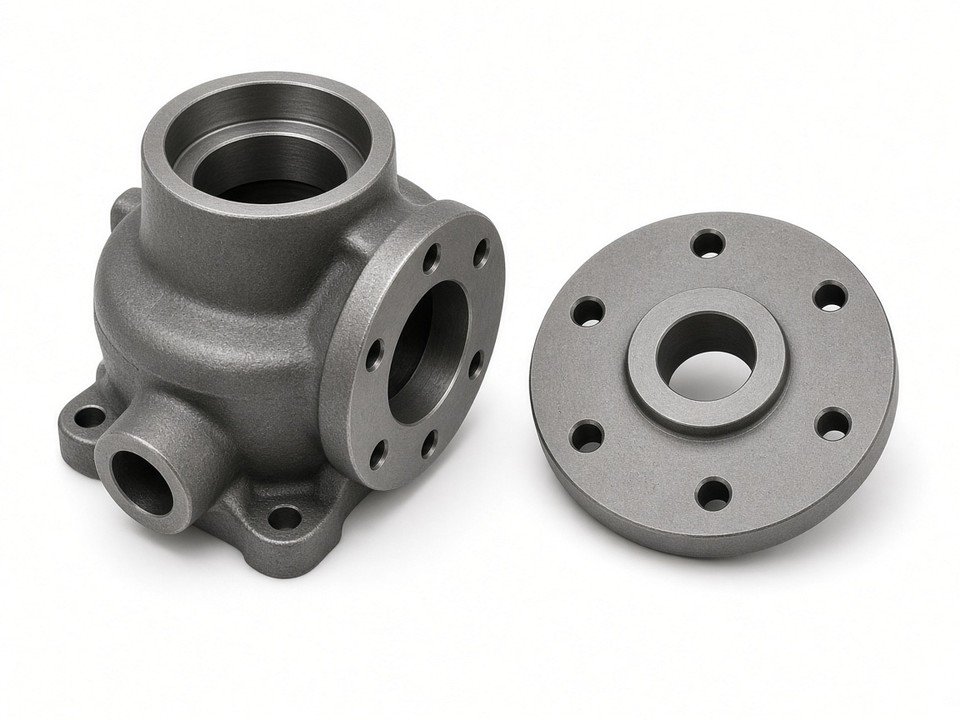
We frame the decision around constraints that affect the finished component: mass, stiffness, loads, heat, corrosion, wear, production quantity, casting process, machining features, and cost over the part’s service life. A short list of priorities helps identify the right material family; the specified grade and casting route complete the decision. For terminology, see Aluminium casting.
Choose Cast Aluminum When
Cast aluminum is a strong candidate when low weight is a priority, when good heat transfer is useful, or when corrosion exposure makes aluminum’s surface behavior advantageous. It is often considered for housings, transport components, and lightweight equipment parts. Verify the selected alloy’s strength, temperature capability, casting quality, and finish requirements against the part’s actual loads and environment.
Choose Cast Iron When
Cast iron is often a good fit when the design prioritizes rigidity, vibration damping, wear resistance, or service at temperatures beyond the capability of common cast aluminum alloys. Typical examples include machine bases, pump bodies, engine components, and heavy-duty housings. Select gray, ductile, or compacted graphite iron according to the balance of damping, strength, toughness, and machinability the design needs.
Match the Material to the Application
The same component category can lead to different answers depending on its duty cycle. Examples can narrow the field, but they do not replace load, environment, and failure-risk review.
- Automotive and transportation: Weight reduction may favor cast aluminum for suitable housings or transport parts; heat, impact, wear, and load requirements may instead point to a specific cast iron grade.
- Machinery: A machine structure that must resist vibration and retain a stable cutting platform often benefits from gray iron’s damping, while covers and less load-critical parts may have different priorities.
- Pumps and HVAC: Consider fluid compatibility, pressure or temperature conditions, corrosion protection, sealing faces, and the consequence of a casting defect—not just weight or machinability.
- Construction and agricultural equipment: Impact, abrasion, outdoor moisture, service access, and repair expectations can be central to the selection for heavy-duty housings and working components.
A Practical Material-Selection Checklist
Before requesting a casting or CNC machining quote, capture the decisions that drive material, process, and inspection. This makes supplier comparisons more meaningful and helps prevent late changes to stock, finish, or acceptance criteria. Further process detail lives under cast iron material pages.
-
1
Define Loads, Weight, and Operating Conditions
Document static and impact loads, required stiffness, target mass, temperature range, vibration, wear, and exposure to moisture or chemicals. Note the duty cycle and likely failure risks.
-
2
Confirm Casting and CNC Requirements
Share the part geometry, expected production volume, preferred or required casting route, machining stock, datum scheme, critical tolerances, and surface-finish requirements.
-
3
Evaluate Quality and Supplier Capability
Ask how alloy or grade is verified, how casting defects and porosity are controlled, whether heat treatment is required, and how the CNC supplier will inspect critical features. For demanding or safety-critical uses, plan prototype evaluation and appropriate validation.
-
4
Compare Total Cost and Sustainability
Compare part mass, casting yield, CNC time, finishing, inspection, transport, maintenance, expected service life, and recyclability over the anticipated production and use cycle.
Frequently Asked Questions
Is CNC Aluminum Stronger Than Cast Aluminum?
“CNC aluminum” describes aluminum that has been machined; it does not identify a material grade. A machined wrought alloy may have different properties from a cast alloy, but compare specific alloys, tempers, and conditions before drawing a strength conclusion.
For a CNC housing or frame blank, when do we lean cast aluminum vs cast iron?
For CNC finish-machining of a cast blank, lean cast aluminum when mass, heat transfer, or corrosion behavior dominates and the blank quality supports sealing or bearing faces. Lean cast iron when stiffness, damping, wear, or higher service temperature drives the design—and tell us graphite form (gray vs ductile), hardness band, and machining stock so the route matches the blank, not a wrought bar.
What Type of Aluminum Is Good for Machining?
The answer depends on whether the starting material is cast or wrought and on strength, finish, and dimensional requirements. A356 and A380 are common cast options, but they serve different casting contexts and should be confirmed against the application and required condition.
What casting blank details should an RFQ include before we CNC it?
Send the casting drawing plus finish stock, blank condition (as-cast / rough-machined / stress-relieved), critical sealing or bearing faces, hardness band if any, and acceptance criteria. That lets us plan tooling, dust control, and inspection for the real blank instead of quoting as if it were wrought bar.
Final Recommendation: Choose for the Part’s Real Constraints
For most projects, the reliable decision is to select the alloy or iron grade and casting process that meet performance and quality requirements at the lowest total lifecycle cost. Choose cast aluminum when mass, heat transfer, or corrosion behavior is a leading advantage; choose cast iron when the specified grade’s stiffness, damping, wear behavior, or temperature capability better matches the duty.
Before releasing a design, review the drawing, material specification, casting allowance, critical machined features, and inspection requirements with both the casting and machining supplier. We work with customers to review drawings, machining processes, and dimensional verification needs for prototype development, repeat orders, and production runs, subject to project requirements.
Discuss your CNC project
We operate under ISO 9001 (HIC241500), ISO 13485 (04526MDQ00014R100), and AS9100D/EN9100 (CN044900)—the same primary QMS set listed on our About page. We also hold ISO 14001 (HIC241501) and IATF 16949 (0565487); confirm which certificates apply to your drawing package and end-use before release.
Need help reviewing a cast part for CNC machining?
Share your drawing, material specification, production needs, and critical inspection requirements with our team. We’ll review the machining considerations and help clarify the information needed to quote your component.