YJCNC · CNC Machining
PETG CNC Machining for Custom Plastic Parts
We manufacture custom CNC-machined components to your drawings and specifications. For every PETG part, I review the material grade, geometry, dimensional tolerances, appearance requirements, and assembly function before we recommend a machining route.
PETG is often chosen for parts that need machinability, toughness, and a clear or translucent appearance. The finished result still depends on the specific grade and on how the part is cut, deburred, inspected, and prepared for assembly.
A PETG Part Needs More Than a Material Callout
“PETG” alone may not define everything needed to make a part consistently. Available grades can differ in color, transparency, dimensions, and other characteristics. If your application requires a particular grade or supplier specification, please include it with the drawing.
I do not treat PETG as interchangeable with PET. The material names are related, but their properties and machining behavior may differ. We use the grade specified for your project as the basis for review. If the grade is not yet selected, tell us how the component will be used and which properties matter most.
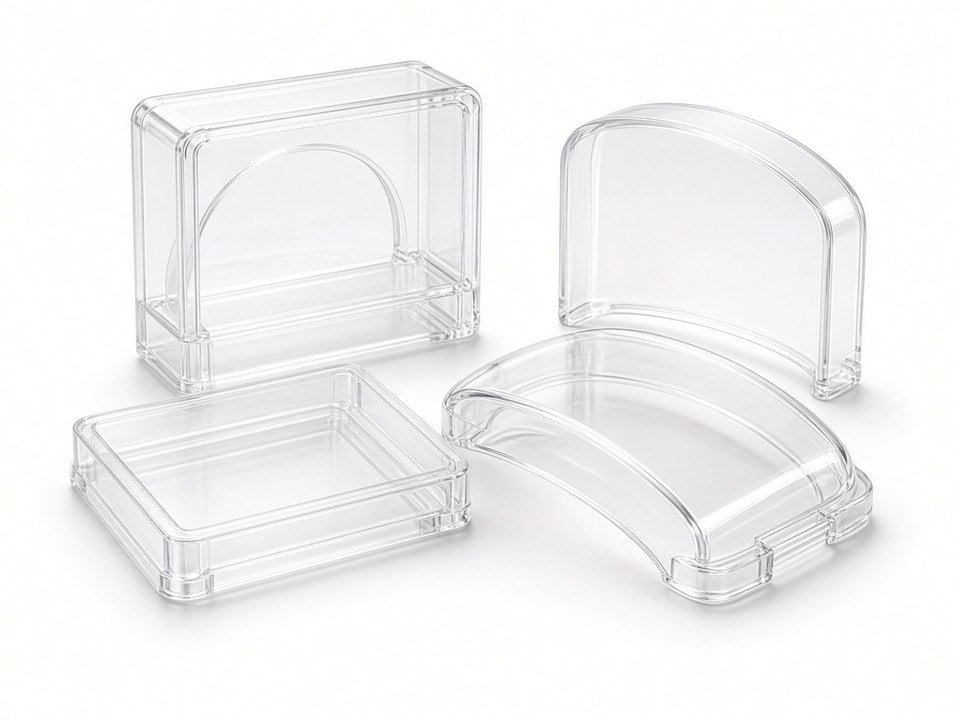
Clear or translucent PETG needs a visual review
Machining may leave visible tool marks, edge effects, or localized changes in appearance. A transparent material callout does not by itself guarantee optical clarity after machining.
We review the requested finish and visible surfaces before quoting, so the appearance standard is agreed before production begins.
How We Review a PETG Machining Project
I assess the part as a complete manufacturing requirement, not as a quote based on material and quantity alone. My review covers the following areas.
Material identification
Grade, color, transparency, and any required material documentation.
Part geometry
Wall thicknesses, pockets, holes, threads, and slots, including features that affect workholding or tool access.
Drawing tolerances
Critical dimensions, datum references, and geometric requirements.
Appearance
Which faces are visible, the required surface condition, and whether tool marks or edge finishing are acceptable.
Assembly function
Mating features, clearance or interference requirements, and the fit expected with adjacent parts.
Order profile
Prototype, repeat order, or production quantity, subject to the project's requirements.
If a drawing leaves an important requirement open, such as whether a clear face is cosmetic or functional, I will raise that question during quotation review.
CNC Processes for Different Part Geometries
We select a process according to part geometry and job requirements. Having a machine type in our inventory does not replace a material- and part-specific feasibility review.
CNC milling
Suited to prismatic components such as housings, brackets, plates, covers, and parts with pockets or multiple faces. Our listed inventory includes 3-axis and 4-axis machining centers, as well as 5-axis CNC machines.
CNC turning
Appropriate for round parts such as sleeves, bushings, spacers, and shafts. For components that combine turned and milled features, we can review whether a turn-mill route is suitable.
Swiss-type machining
Available for small-diameter or slender components where the geometry and dimensions support the process. The final route depends on the drawing, material grade, and production requirements.
I confirm the proposed process during project review. If a part has features that are difficult to machine cleanly or inspect, we can discuss the relevant design and acceptance requirements before production.
Managing Burrs, Heat, and Surface Appearance
Plastic machining requires attention to how cutting affects the part, not only whether the toolpath can produce the nominal geometry.
Burrs and edge condition
Holes, slots, intersecting features, and thin edges may form burrs. I review critical edges and deburring expectations so the edge treatment suits the part's use and assembly.
Heat during cutting
Excessive heat can affect cut quality and dimensional stability. Parameters and operation sequence are set for the specific material and geometry, not assumed from another plastic grade.
Visible tool marks
Transparent and translucent surfaces can show machining traces more readily than opaque ones. Please identify cosmetic faces and state the appearance standard you need.
Part handling
Thin walls and small features can be sensitive to clamping and handling. Workholding implications are part of the manufacturing assessment.
If your application needs a particular optical appearance, tell us whether you need a clean machined surface or a defined visual standard. We will assess whether the requested finish can be supported by the proposed route.
Dimensional Control and Assembly Fit
We manufacture to customer drawings and set inspection requirements around the dimensions that matter to the part. Our inspection resources include a coordinate measuring machine, optical measuring systems, height measuring instruments, micrometers, calipers, pin gauges, and other dimensional gauges.
The listed precision of a machine does not guarantee that every feature will meet a given tolerance. Achievable tolerances depend on the part, grade, geometry, dimensions, inspection method, and acceptance criteria, so I review critical dimensions against the drawing before we confirm the approach.
For PETG components, I pay particular attention to:
- Hole diameters and positions
- Mating faces and overall dimensions
- Slots, clearances, and locating features
- Threaded features, where specified and suitable for the design
- Concentricity or profile requirements, when called out
For assembly-sensitive parts, please include mating component information or the required fit class. This shows which dimensions need closer attention and how I should plan verification.
Choosing PETG for Your Application
PETG may be a candidate when a project calls for a machinable plastic part with some toughness and a clear or translucent appearance. The choice should be made against the actual application, not just the material name.
If your design already specifies PETG, we will review that grade and the drawing. If the material is still open, send us the use case and required performance so we can assess the machining requirements.
When comparing materials or reviewing a design, consider:
- Whether the part is structural, protective, visual, or used for positioning
- Whether transparency or translucency is needed across the whole part or only selected faces
- The dimensional precision needed for mating components
- The appearance expected at edges, holes, and machined surfaces
- The specified grade and any project documentation requirements
Suitable Projects and Production Requirements
Our CNC machining services support custom components for prototype development, repeat orders, and production runs, subject to project requirements. PETG parts may be considered for housings, covers, panels, spacers, bushings, and other custom components when the geometry and material specification are suitable.
We operate quality management systems certified to ISO 9001, ISO 13485, AS9100D, ISO 14001, and IATF 16949. Certification applicability depends on the relevant scope and project requirements. If your purchase requires specific inspection records or supplier documentation, include those in your inquiry.
25
Listed 3-axis machining centers
1
Listed 4-axis machining center
8
5-axis CNC machines
43 / 15
CNC lathes / turn-mill machines
Alongside Swiss-type and automatic turning equipment, this range lets us evaluate different geometries and production needs. The appropriate process and capacity are confirmed for each project.
What to Include in a PETG RFQ
To help me assess your PETG CNC machining project, please send the following information. Items you cannot yet confirm can be marked as open.
You can email the information to info@yjcncmachining.com. Our address is Yabian Community, Shajing Street, Baoan District, Shenzhen, China.
- 01Material grade and supplier specification, if known
- 022D drawing and 3D model, with revision level
- 03Quantity for the initial order and expected repeat demand, if applicable
- 04Critical dimensions and tolerances
- 05Appearance requirements, including clear or translucent expectations and cosmetic faces
- 06Edge and surface-finish requirements
- 07Assembly details, such as mating parts or fit requirements
- 08Inspection and documentation needs
- 09Target delivery schedule, if one has been established
Request a PETG Machining Review
Send me your material grade, drawing, quantity, and appearance requirements. We will review the part geometry, tolerances, surface expectations, and assembly fit to determine a suitable manufacturing approach and prepare a quotation.
Contact YJCNC at info@yjcncmachining.com to discuss your PETG CNC machining requirements.