ISO 13485 quality management system
ISO 13485 Certified CNC Machining for Medical Device Components
We machine turned and milled components to customer drawings, with production managed under an ISO 13485 quality management system. If you are qualifying a machining supplier for a medical device program, we explain what our certificate covers, what it does not, and what we need to quote accurately.
Certification applies to the holder, scope, activities, and validity stated on our current certificate—not automatically to every part or finished device.
25
Three-axis machining centers
43
CNC lathes
±0.01 mm
Listed precision for most CNC processes
Certificate scope
Confirm the scope before sending an RFQ
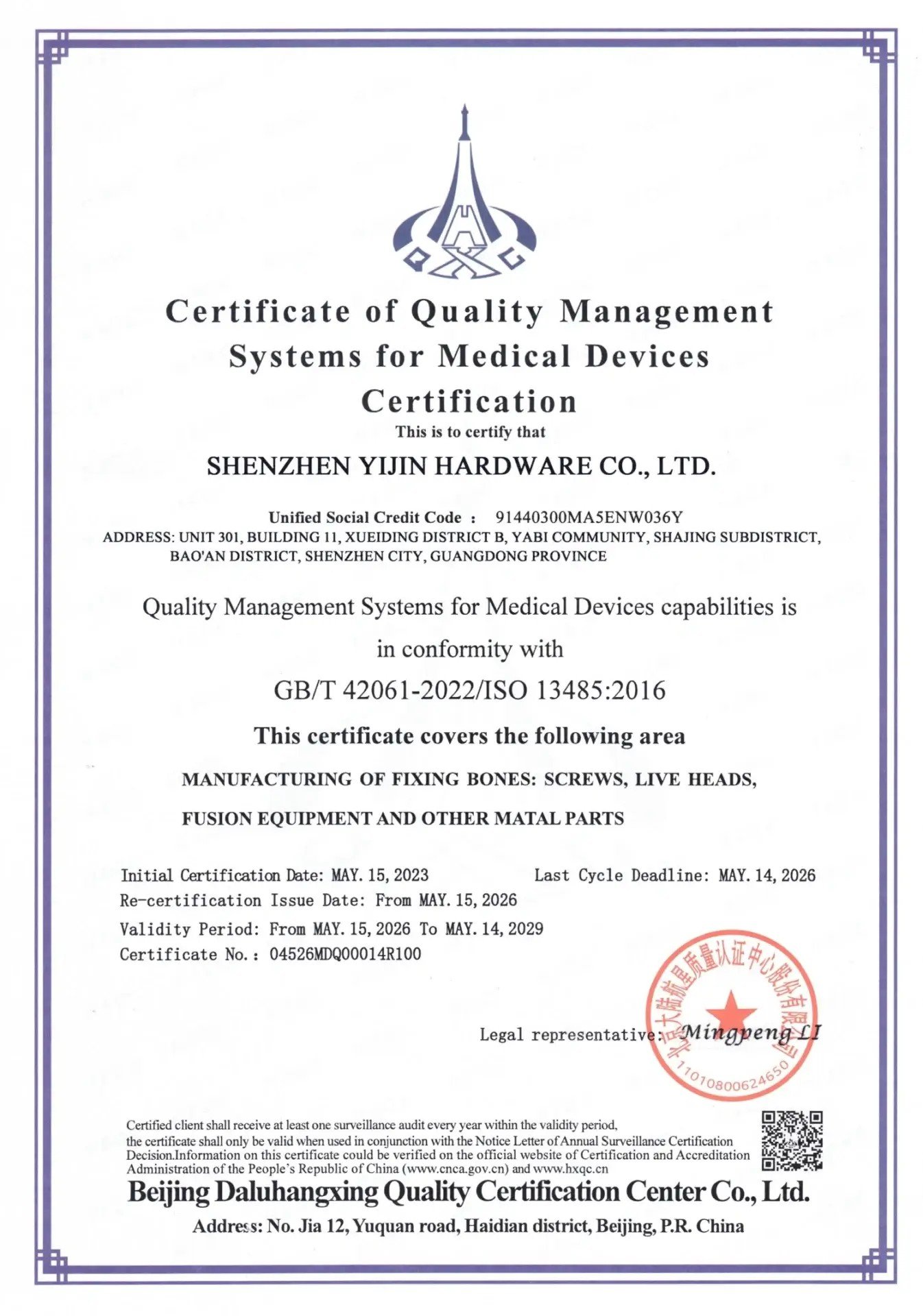
The details below are taken from our current certificate. We can provide a copy on request. Where the certification body publishes a certificate directory, you can also verify the status there.
- Certificate holder
- SHENZHEN YIJIN HARDWARE CO., LTD.
- Certificate number
- 04526MDQ00014R100
- Issuing certification body
- Beijing Daluhangxing Quality Certification Center Co., Ltd. (HXC)
- Valid until
- Current validity period: 15 May 2026 – 14 May 2029 (re-certification issue from 15 May 2026; initial certification 15 May 2023)
- Certified scope
- Manufacturing of fixing bones: screws, live heads, fusion equipment and other metal parts (GB/T 42061-2022 / ISO 13485:2016)
- Covered production activities
- Manufacturing activities within the stated medical bone-fixation metal parts scope on the certificate; credit code 91440300MA5ENW036Y. Address on certificate: Unit 301, Building 11, Xueiding District B, Yabi Community, Shajing Subdistrict, Bao'an District, Shenzhen City, Guangdong Province
Important distinction
A certified quality system is not product approval
ISO 13485 certification shows that our quality management system meets the standard’s requirements for the scope listed on the certificate. It does not mean a part, material, or finished device is approved for use.
Medical device regulatory status depends on your device classification, intended use, regulatory submissions, and the approval pathway in your target market. We do not claim implant-grade status or patient-contact suitability for any component by default.
If your part requires a specific material certificate, biocompatibility data, or a defined cleanliness requirement, include it with your drawing. We will review whether we can meet it and under what conditions.
Controlled production
Document control, risk management, and traceability
We apply controls to the processes and records within our scope. Project-specific requirements are reviewed and confirmed before production; we do not assume controls that have not been agreed or documented.
01 · Documents and records
Control the production baseline
Before production, we set up the controlled drawing revision, process routing, and inspection plan. Drawing or process changes are reviewed and recorded before revised parts are released. Order records include first-article and in-process inspection data where required by the drawing or quality agreement. Agreed retention periods are applied to order records.
02 · Risk in production
Focus controls on critical features
For a new part or changed process, we review features likely to cause nonconformity, such as thin walls, small-diameter bores, thread engagement, and burr-prone edges. Controls may include tooling checks, in-process measurement, and first-article verification. Tell us at RFQ stage if you require a formal process FMEA; we will confirm feasibility and required inputs.
03 · Traceability
Agree the level for each order
Traceability depends on the part and customer agreement. Options typically include order-level, lot or batch, and serialized identification. We confirm the level during quotation review and record it on order documents. Specify whether material certificates must be tied to particular lots.
Inspection capability
Measurement resources for drawing-based verification
Measurement methods, sampling plans, and acceptance criteria are defined per part in the inspection plan. We can align them with your incoming inspection requirements.
| Inspection equipment | Quantity / range | Typical use |
|---|---|---|
| Coordinate measuring machine (CMM) | 1 | 3D dimensional and geometric inspection |
| Optical measuring systems (2D vision) | 5 | Profile, hole position, and dimensional measurement |
| Height measuring instruments | 2 | Height and step dimensions |
| Concentricity measuring instrument | 1 | Concentricity on turned parts |
| Surface roughness tester | 1 | Surface roughness verification |
| Rockwell hardness tester | 1 | Material hardness checks |
| Coating thickness gauge | 1 | Coating thickness measurement |
| Digital and dial calipers | 30 | General dimensional inspection |
| Micrometers | 10 | Precision diameter measurement |
| Thread ring and plug gauges | M1.0 to M16 sets | External and internal thread inspection |
| Pin gauges | 1.0 to 16.0 mm sets | Hole diameter and fit |
Machining capacity
Processes and component types
We machine to customer drawings. Tolerances are set by your drawing; tighter features require a process review before quotation.
Listed precision
Most CNC processes: ±0.01 mm
Automatic turning: ±0.02 mm
Milling centers
25 three-axis CNC machining centers, 1 four-axis machining center, and 8 5-axis CNC machines.
Turning and turn-mill
43 CNC lathes, 30 automatic lathes, 15 turn-mill machines, and 7 gang-type CNC lathes.
Swiss-type turning
10 Swiss-type lathes: 4 five-axis, 2 six-axis, and 4 other types.
Threaded components
20 screw machines for threaded fasteners.
Typical medical-related components
- Shafts, pins, and bushings for instrument and actuator assemblies
- Housings and brackets for equipment and diagnostic devices
- Small turned connectors and fittings
- Threaded components for assembly and fixturing
- Complex parts combining turning and milling features in one setup
Supplier fit
Is our process a fit for your part?
Our ISO 13485 system suits precision machined components with defined drawings, material, and inspection requirements—particularly repeat-production OEM programs that need documented control.
We review drawings for features our equipment and inspection tools can verify before accepting a project. If we cannot verify a feature with equipment we hold, we will tell you before quoting. Parts requiring processes outside our listed equipment, such as special heat treatment or coating types we do not run in-house, may need an approved external source. We can identify those operations early.
What to include in your RFQ
Send the requirements that define the part, its acceptance criteria, and your supplier controls.
- 013D model and controlled drawing with revision level
- 02Material specification and required material certificates
- 03Applicable standards or customer specifications, including internal quality requirements
- 04Prototype, first-article, and production quantities
- 05Surface finish, coating, and cleaning requirements
- 06Traceability level and required quality records
- 07Your supplier audit checklist or quality agreement, if applicable
Common questions
Before you qualify a machining supplier
Does ISO 13485 certification approve my component for medical use?
No. It applies to our quality management system within the certificate scope. Regulatory status and suitability depend on your device, intended use, materials, and applicable approval pathway.
Can you meet a specific traceability or inspection plan?
We review the requested traceability, sampling, methods, and acceptance criteria for each part. Include your requirements in the RFQ so we can confirm the applicable controls and records.
What if the part needs a process we do not run in-house?
We will identify out-of-scope operations, such as special heat treatment or coating types we do not run in-house, during review and discuss whether an approved external source is required.
Start your supplier review
Let’s review your requirements against our certified scope
Send your applicable standards, material requirements, and supplier audit checklist. We will review them against our ISO 13485 scope and respond with what we can meet, what needs confirmation, and any items that require an external process.
You can also include the controlled drawing, material specification, required records, and traceability expectations so we can assess the part and quotation requirements together.
Email: info@yjcncmachining.com
Office: Yabian Community, Shajing Street, Baoan District, Shenzhen, China