CNC Machining for Engineering Plastics
PBT CNC Machining for Electrical and Connector Components
We CNC-machine PBT parts to your drawings, including insulating housings, connector bodies, spacers, bushings, and mounting components. We work from a defined grade, a dimensioned drawing, and a clear quantity, so we can assess feasibility and quote accurately.
Send us your PBT grade, drawing, performance specification, and quantity.
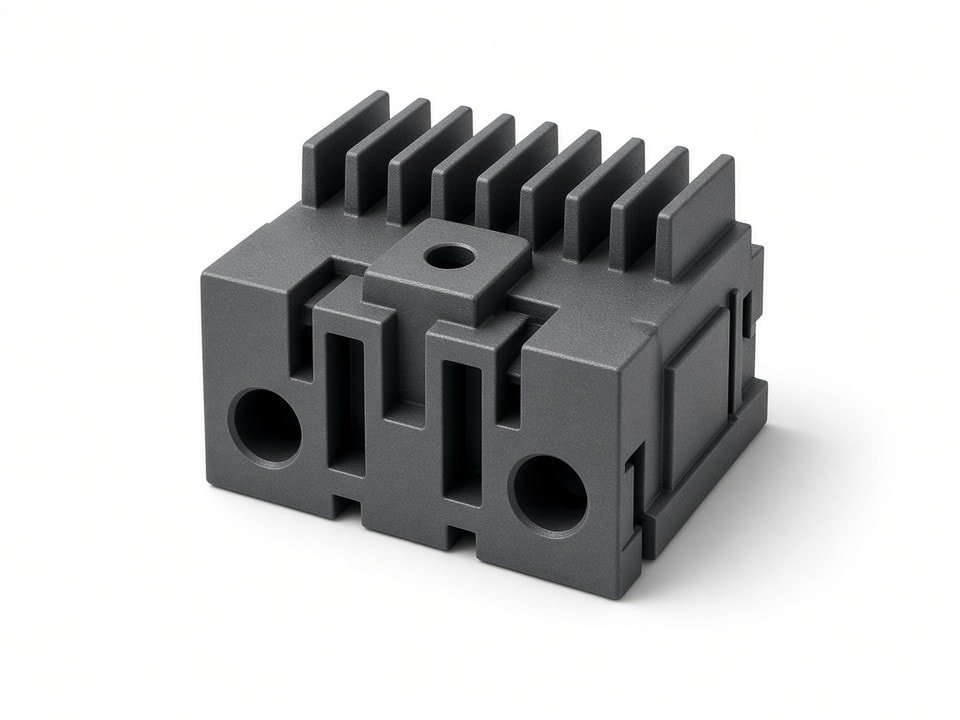
What We Machine from PBT
Most of our PBT work is prototype and low-volume production, along with repeat orders for parts still being validated for molding. We machine both.
-
Connector parts
Connector housings, inserts, carrier components, and connector bodies.
-
Insulating hardware
Insulating spacers, standoffs, bushings, and turned sleeves or pins where plastic replaces metal.
-
Coil formers and bobbins
Coil formers and bobbin-type parts for prototype and low-volume runs.
-
Terminal blocks and brackets
Terminal blocks and mounting brackets for electrical assemblies.
How PBT Behaves on the Machine
PBT is a semi-crystalline thermoplastic, and its machining behavior depends heavily on whether it is filled. Unfilled grades cut cleanly but can form long, stringy chips that wrap around tooling. Glass-filled grades produce short chips and cut more abrasively, which wears tool edges faster and can leave fine fibers on the surface if feeds are not matched to the material.
Heat control
Drilling and deep-pocket milling generate heat that can soften the material, causing smeared holes and dimensional drift. We adjust speeds, feeds, and cooling for each grade and geometry, and we check first articles before running production.
Clamping thin walls
PBT can deform under point loads. We use fixtures that support the part evenly and avoid over-tightening. For parts with critical flatness or bore relationships, we check the finished geometry after release from the fixture.
Grades and Fillers Change the Job
The grade you specify shapes how we plan the job. These are the variables we review first.
- Reinforcement type and content
- Glass-fiber content influences stiffness, dimensional stability, and tool wear. Percentages vary between suppliers, so we need the actual grade designation.
- Dimensional stability
- PBT absorbs less moisture than many engineering plastics, but it still changes dimension with humidity and temperature. If your drawing specifies a conditioning state or measurement temperature, state it on the drawing.
- Working temperature
- Continuous service temperature and heat deflection values come from the datasheet for that specific grade. We do not assume them. Send the datasheet so we can review the values against your application.
- Color, additives, and availability
- Some colored or flame-retardant grades behave differently under cutting, so they should be identified before we quote. If we cannot source a specified grade, we will tell you before the order is placed. We do not substitute a grade without your written approval.
Machining Processes We Select for PBT Parts
Process selection depends on geometry and volume. Select a process to see where it fits.
CNC turning
Suited to cylindrical parts such as bushings, spacers, and pins. We run 43 CNC lathes and use turning for concentricity-critical features where the part is primarily round.
CNC milling
Suited to housings, brackets, and parts with flat faces, pockets, or slots. Our 3-axis and 5-axis machining centers cover most prismatic PBT parts. Multi-sided parts can be completed in fewer setups, which reduces cumulative error.
Turn-mill machining
Combines turned and milled features in one setup. This is useful for connector bodies that have a round section plus cross-holes or flats.
Swiss-type machining
Applies to small, slender PBT components where support close to the cut is needed. We run 5-axis, 6-axis, and other Swiss-type lathes for this work.
Drilling and tapping
Secondary operations on most PBT parts. For threaded features in plastic, we may recommend inserts or a change in thread form, and we review that with you before production.
Electrical and Flame Requirements
Insulation, flame classification, and certification status are properties of the material and the finished product design. Machining does not create them, and we do not confirm compliance based on the material name alone. Because PBT is widely used in electrical parts, it is tempting to assume any PBT part meets a given requirement. We do not make that assumption.
What we can do
- Machine parts to your drawing so wall thicknesses, creepage-related dimensions, and insulating features match the specified geometry.
- Keep material traceability records linked to each production lot, where your supplier provides lot identification.
- Measure dimensions that affect insulation spacing and assembly fit, and report them against the drawing.
- Flag operations that may reduce a critical dimension or expose a surface your specification requires to stay intact.
What we need from you
- The material supplier's datasheet for the exact grade.
- The applicable standards, including any flame classification, dielectric, or tracking requirements for the finished part.
- Whether each requirement applies to the material, the finished component, or the end product.
Certifications: Our quality management system is certified to ISO 9001, ISO 13485, AS9100D, ISO 14001, and IATF 16949, subject to the scope stated on each certificate. These certifications do not automatically extend to every electrical product or market requirement. If your project needs specific approvals, tell us at the RFQ stage so we can confirm whether we can meet them before you commit to a schedule.
Inspection for Plastic Parts
We measure PBT parts with the same equipment we use for metal, adjusted for the material. Our resources include a coordinate measuring machine, five optical measuring systems for profile and hole position, a concentricity measuring instrument, height measuring instruments, and a surface roughness tester. For manual checks we use digital calipers, micrometers, height gauges, pin gauges, and metric thread gauges from M1.0 to M16.
-
Conditioning: we measure after parts reach the temperature and humidity condition the drawing specifies. If we cannot control a specified condition, we will say so during quoting and suggest a practical alternative.
-
Fit and threads: we check hole diameters with pin gauges, confirm fit against mating parts where specified, and verify threads with gauges, recording results for each inspection lot.
-
Reports: when your purchase order requires them, we provide inspection reports showing measured values against the drawing.
Tolerances and Surface Finish on PBT
Our CNC equipment achieves tight tolerances on many features. For plastic, the achievable tolerance depends on grade, part size, wall thickness, and sensitivity to moisture and heat. Tolerances that are easy on metal can be difficult on plastic, particularly on large flat faces and long thin walls.
We review tolerances on each drawing and flag where a tolerance is impractical or a feature needs a different method. Where it helps, we suggest relaxing non-functional tolerances and keeping tight tolerances only on features that affect assembly or electrical performance.
Surface finish
Machined PBT faces are typically matte and show tool marks, which differs from molded surfaces. If a part needs a cosmetic surface, a smooth sealing face, or a specific roughness value, state it on the drawing. We measure roughness with a surface roughness tester when a value is specified.
CNC Machining or Molding?
We machine prototypes, design validation parts, bridge production while a mold is being built, and low-volume runs where mold cost would be hard to recover. Machining also suits frequently changing geometry, because a drawing revision is cheaper to implement than a mold change.
Machining is the practical route for
Prototypes, design validation, pre-production parts, bridge supply during tooling, and low-volume runs with changing geometry.
Injection molding is usually better for
High-volume production of simple, stable PBT parts. We can discuss the volume at which molding becomes the better route for your part.
What to Send with Your RFQ
To quote accurately, we need the following. If you do not yet have a drawing, send a sample part or a sketch with critical dimensions marked, and we will identify what is still missing.
-
1. Material grade
Manufacturer, grade name, reinforcement content if known, and the datasheet.
-
2. Drawing
Dimensions, tolerances, critical features, thread specifications, and surface requirements.
-
3. Performance specifications
Operating temperature range, insulation or dielectric requirements, flame classification if applicable, and the governing standard for each.
-
4. Quantity
Prototype quantity, first order quantity, and expected annual volume.
-
5. Inspection requirements
First article report, dimensional reports per lot, or material traceability records.
-
6. Delivery
Required delivery date and shipping location.
Request a Quote
Send us your PBT grade, drawing, performance specification, and quantity. We will review machinability, confirm which requirements we can meet, and return a quotation with the processes and inspection we propose.
- info@yjcncmachining.com
- Phone
- Address
- Yabian Community, Shajing Street, Baoan District, Shenzhen, China