CNC machining · Engineering plastics
Polycarbonate PC CNC Machining for Custom Components
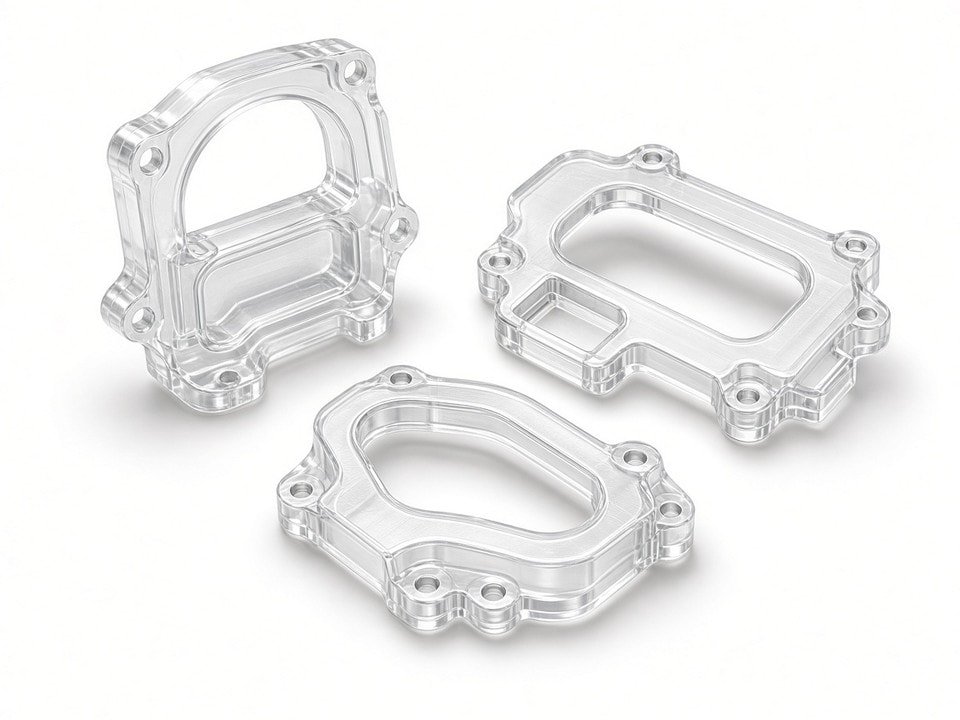
We machine custom Polycarbonate (PC) components to customer drawings, including instrument windows, protective covers, housings, and precision turned parts. Share your drawing, material grade, transparency requirements, and operating conditions so we can review the geometry, machining route, and inspection needs for your RFQ.
We assess each part against its specified grade, functional use, appearance criteria, and inspection requirements.
25
Three-axis machining centers
8
5-axis CNC machines
43 + 15
CNC lathes and turn-mill machines
ISO
9001, 13485, and AS9100D certified quality management systems
Equipment and certification applicability depend on the component, project scope, and agreed requirements. Listed machine precision figures are not a guarantee of achievable tolerance on every PC part.
Application fit
PC parts for industrial applications
Polycarbonate is chosen for tough engineering plastic components and, in some grades, visual transparency. We review the intended use and specified grade before quoting rather than assuming every stock material will meet a particular clarity, impact, chemical-resistance, or service-life requirement.
Windows and protection
Instrument windows, display covers, guards, and protective shields.
Enclosures and equipment
Precision equipment housings and custom features for engineered products.
Turned components
Spacers, sleeves, bushings, rings, and other rotational parts.
Mounting features
Custom brackets, slots, holes, and assembly interfaces made to drawing.
Process selection
We select the machining route around the part
We assess geometry, feature access, quantity, visible or functional surfaces, and required quality checks during drawing review. The proposed machine and setup depend on the specific component.
01
CNC milling
For covers, windows, housings, pockets, slots, and mounting features.
02
CNC turning
For sleeves, bushings, rings, and other rotational components.
03
Turn-mill machining
For parts combining turned diameters with milled features.
04
Swiss-type machining
For suitable small, slender components where the geometry and requirements fit.
Appearance requirements
Define what “transparent” means for your part
A clear protective cover and a component with controlled visual quality may call for different acceptance criteria. Machined appearance depends on the PC grade, stock condition, geometry, cutting process, and any agreed post-processing.
We do not claim optical-grade surfaces or specific light-transmission performance without validation. If appearance or transmission is critical, include the acceptance criteria, inspection method, and any reference sample or applicable specification. We can then assess what is measurable and whether the proposed manufacturing and finishing approach is suitable.
Information we review
- 01Material grade: Exact grade or design material specification; we do not substitute without customer approval.
- 02Appearance: Transparency, color, visible faces, and acceptable machining marks.
- 03Environment: UV exposure, temperature, mechanical loading, chemicals, cleaners, or process fluids.
- 04Compliance: Flame, regulatory, industry-specific, traceability, and material documentation requirements.
We confirm material availability and documentation requirements during project review. If the grade is not selected yet, share the part function and operating conditions so we can identify what needs review.
Part condition and fit
We review stress, scratches, burrs, and stability
PC parts can be sensitive to machining conditions and handling, especially when appearance matters or a design includes thin sections. We review wall thickness, unsupported areas, sharp internal corners, and clamping surfaces because these can affect part condition during machining and inspection.
Machining stress
We review geometry and machining sequence, noting thin walls and features that may need particular process attention.
Scratches and handling marks
We agree which faces are cosmetic or visible and define handling and packaging expectations.
Burrs and edges
We identify edges requiring controlled deburring, especially around holes, slots, and mating features.
Dimensional stability
We consider how dimensions will be inspected and which features control fit or assembly.
These factors are evaluated against the specific drawing. We recommend distinguishing functional dimensions from cosmetic requirements in the final acceptance criteria.
Quality and inspection
Tolerances are reviewed for the actual part
We manufacture to customer drawings and review tolerances for feasibility before production. Our listed CNC equipment has stated precision figures of ±0.01 mm for several machine categories; this is not a guarantee of the tolerance achievable on every PC part. Actual results depend on geometry, material, setup, process, and measurement method.
Our inspection resources include a coordinate measuring machine, optical measuring systems, height measuring instruments, micrometers, calipers, and other dimensional gauges. We select inspection methods according to the drawing and agreed control plan.
Quality controls to specify in your RFQ
- Critical dimensions and functional datums
- Inspection method and sampling expectations
- Dimensional report or special documentation needs
- Revision control and repeat-order expectations
Our quality management systems are certified to ISO 9001, ISO 13485, AS9100D, ISO 14001, and IATF 16949. Certification applicability depends on the relevant scope and project requirements.
Finish and manufacturability
Agree the finish for each visible face
A machined finish may suit internal or non-visible features, while a transparent window or cover may need additional appearance requirements. Any polishing, coating, or other finishing step must be assessed against the PC grade and design.
Tell us which faces are visible, whether machining marks are acceptable, and what post-processing is specified. We will review the requested finish and confirm what can be quoted; we do not represent an unverified result as optically clear or suitable for a defined transmission level.
Where our PC machining fits
Our CNC milling, turning, and turn-mill capabilities support custom PC parts for industrial equipment, instrumentation, automation, and other engineered products. We review prototypes, repeat orders, and production runs based on the part, volume, and inspection plan.
Drawing details we look for
- Thin walls and large unsupported spans
- Tight tolerances on clear or cosmetic surfaces
- Hole positions and mating features
- Edge conditions, radii, and deburring requirements
- Assembly interfaces and functional datums
- Quantity, revision control, and repeat-order expectations
If the design is still changing, include the current revision and identify features that are not fixed. This helps us focus review on decisions that affect cost, process selection, and part acceptance.
RFQ preparation
Help us review the right details from the start
A clear drawing and a defined appearance requirement help us assess feasibility, inspection needs, and the appropriate machining route. If the design is evolving, tell us what is fixed and what remains open.
Before sending your inquiry, gather:
- Current drawing revision and 3D CAD file, if available
- PC grade or required material specification
- Transparency, color, visible-face, and acceptance criteria
- Quantity, inspection needs, and operating environment
Details to include with your quote request
- 12D drawing and 3D CAD file, if available
- 2Required Polycarbonate grade or material specification
- 3Initial order quantity and expected repeat volume
- 4Transparency, color, and appearance criteria
- 5Critical dimensions and inspection or reporting requirements
- 6Operating environment, including temperature, UV exposure, and chemical contact
- 7Required finishing, packaging, and delivery details
Request a quote
Let’s review your Polycarbonate PC component
Send us your drawings, required transparency, material grade, and operating environment. We will review your requirements, clarify open points, and quote against the agreed scope.
For a complete RFQ, include the quantity, critical dimensions, inspection or reporting needs, finishing requirements, and any handling or packaging expectations.
YJCNC · Yabian Community, Shajing Street, Baoan District, Shenzhen, China