C954 Aluminum Bronze Machining
C954 Aluminum Bronze Machining for Wear-Critical and Corrosion-Exposed Parts
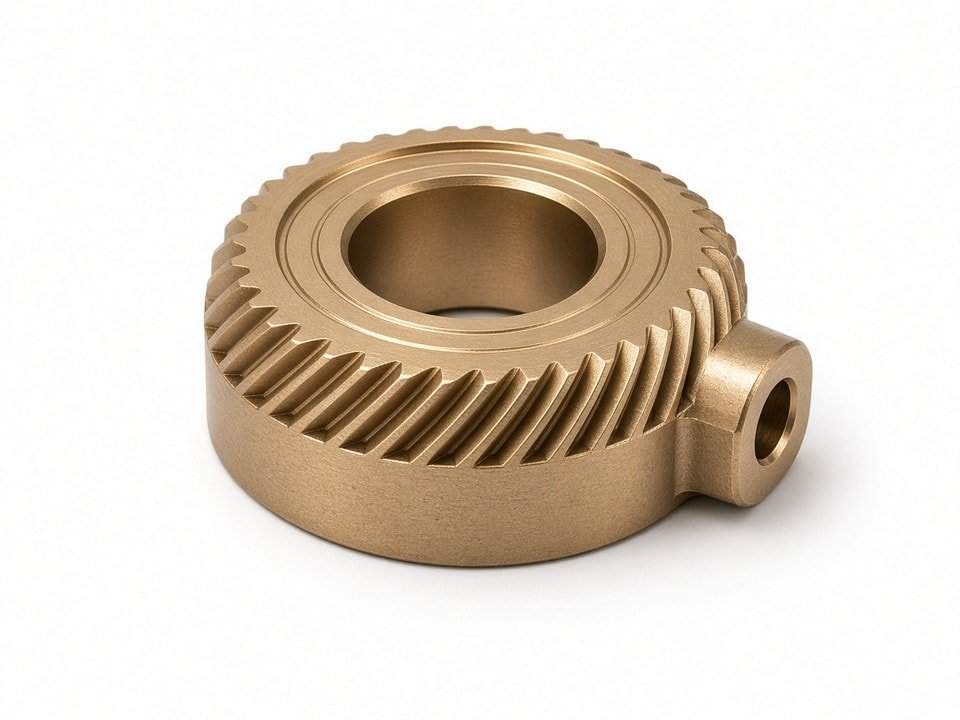
Many C954 parts we receive are bushings, wear rings, valve components and fittings that have to hold dimension under load while sitting in water, chemicals or abrasive media. The material is chosen for that combination of strength and surface durability, and machining it well takes planning.
We review that planning with you before any chips are cut. Send us your drawing, the material standard and the service conditions, and we will return a quote with the machining route and inspection plan we would run.
What C954 Is and Why It Gets Specified
C954 is a copper-aluminum-iron alloy. In practice it is usually specified against the UNS C95400 composition and supplied as bar, rod, tube or forging, depending on the part.
Compared with brass and phosphor bronze, C954 offers higher strength and better resistance to wear and galling. Those properties make it a common choice for bearing surfaces, pump and valve components, marine hardware and parts that slide against steel shafts.
Corrosion depends on the application
C954 is not a catch-all solution. Its corrosion behavior depends on the medium, temperature, flow rate, chloride content and surface condition. We do not promise absolute corrosion resistance for any medium, including seawater. We check whether the material standard on your drawing matches the environment you describe, and we flag cases where a different alloy or surface treatment would serve you better.
Information We Need to Quote C954 Parts Accurately
The material standard controls more of the machining outcome than most people expect. Mechanical properties, hardness and machinability vary between product forms and heat-treatment conditions, so a quote based on "aluminum bronze" alone can change once the material reaches the shop.
| Input | What to send | How it affects your part |
|---|---|---|
| Material standard | Specification number (for example ASTM B150 or B124 for C95400) and temper | Determines bar stock condition, hardness and machining response |
| Product form | Bar, rod, tube, plate or forging, with diameter or thickness | Sets blank size, stock allowance and the choice between turning and milling routes |
| Use environment | Medium, temperature, pressure, load type, cycling | Guides material confirmation and critical-dimension priorities |
| Critical features | Bore, OD, groove, thread, flatness, concentricity, surface finish | Determines inspection method and the operations that need the most control |
| Quantity and cadence | Prototype quantity, first-article need, annual or repeat volume | Decides fixture investment, cycle time and inspection sampling |
| Documentation | Mill certificate, CoC, first-article report, traceability needs | Sets the paperwork that ships with the parts |
How We Machine C954 on Our Equipment
Aluminum bronze work-hardens and tends to form built-up edge on the cutting tool when feeds and speeds are not matched to the material. It also produces long, stringy or tough chips that can mark a finished bore.
We control these effects at the process level rather than correct them at inspection. Select a method to see how we handle it.
Quality Verification for Aluminum Bronze Components
Our quality checks follow the drawing. For a typical C954 job we measure the features that carry the most risk in the application, rather than sampling everything at the same depth.
-
3D dimensional and geometric checks
Form, position and concentricity on critical bores and diameters, measured on our coordinate measuring machine.
-
Concentricity measurement
Applied to rotational parts with tight coaxial requirements.
-
Surface roughness testing
Bearing and sealing surfaces checked against the specified Ra value.
-
Rockwell hardness testing
Confirms the material condition matches the specification on the mill certificate.
-
Optical measurement
Profiles, hole positions and small features that are hard to reach with contact tools.
-
Thread and pin gauge checks
Threaded and fit features verified against go/no-go gauging.
Quality management is covered by ISO 9001, ISO 13485, AS9100D, ISO 14001 and IATF 16949, subject to valid certification scope. We provide documentation that matches your requirements, including material certificates and first-article inspection reports where the project calls for them.
Matching C954 Machining to Your Part
The table below shows the typical starting route for common C954 part families. The final route depends on the drawing, the material form and the quantity, and we confirm it during quoting.
| Part type | Typical size range | Likely route | Main machining risk | What we verify |
|---|---|---|---|---|
| Bushings and sleeves | Small to medium OD, through bore | CNC turning or Swiss-type | Bore finish, concentricity | Bore size, concentricity, Ra |
| Wear rings | Medium OD, thin wall | CNC turning | Distortion in thin walls | Roundness, flatness, OD/ID |
| Valve components | Mixed features, threads and bores | Turn-mill or turning plus milling | Feature position between operations | Position, thread form, pressure-sealing surfaces |
| Marine and pump fittings | Medium to large, flanged | Turning plus multi-axis milling | Flange flatness, bolt-hole pattern | Flatness, hole position, thread checks |
| Pins and small shafts | Small diameter, slender | Swiss-type machining | Deflection, chatter | Diameter, straightness, finish |
| Mounting plates and brackets | Flat, multi-hole | 3-axis or 4-axis milling | Flatness after machining | Flatness, hole pattern, surface finish |
If the part has a thin wall or a long unsupported length, tell us so we can plan support and sequence. If a bearing surface must run against a specific shaft material, include the mating material, because galling risk depends on the pairing as well as the bronze.
Send Us Your C954 Drawing for a Quote
To receive a quotation from YJCNC, send the following to info@yjcncmachining.com:
- Drawing in PDF or native CAD format, with tolerances and surface finish callouts
- Material standard and temper (for example, the ASTM or UNS designation)
- Service environment: medium, temperature, pressure and load type
- Quantity for prototype and for production, plus expected annual volume
- Any required documentation, such as mill certificates, CoC or first-article reports
Phone:
WhatsApp:
Address: Yabian Community, Shajing Street, Baoan District, Shenzhen, China
If the material or environment is unclear, describe what you know and we will tell you what we need to confirm before quoting. Submitting details early lets us check the material route, flag tolerance conflicts and give you a realistic lead time for your schedule.