Custom thermoplastic components
PSU CNC Machining for Heat-Resistant, Dimensionally Stable Parts
We machine custom PSU (polysulfone) components to customer drawings using CNC milling, CNC turning, turn-mill and Swiss-type equipment. When a part needs to hold its shape at elevated temperature, through thermal cycling, or remain clear and stable in service, we assess the material grade and operating conditions alongside the geometry.
Tell us what the part does, which grade you specify and where it will operate. That information helps us develop a machining plan and a useful quotation.
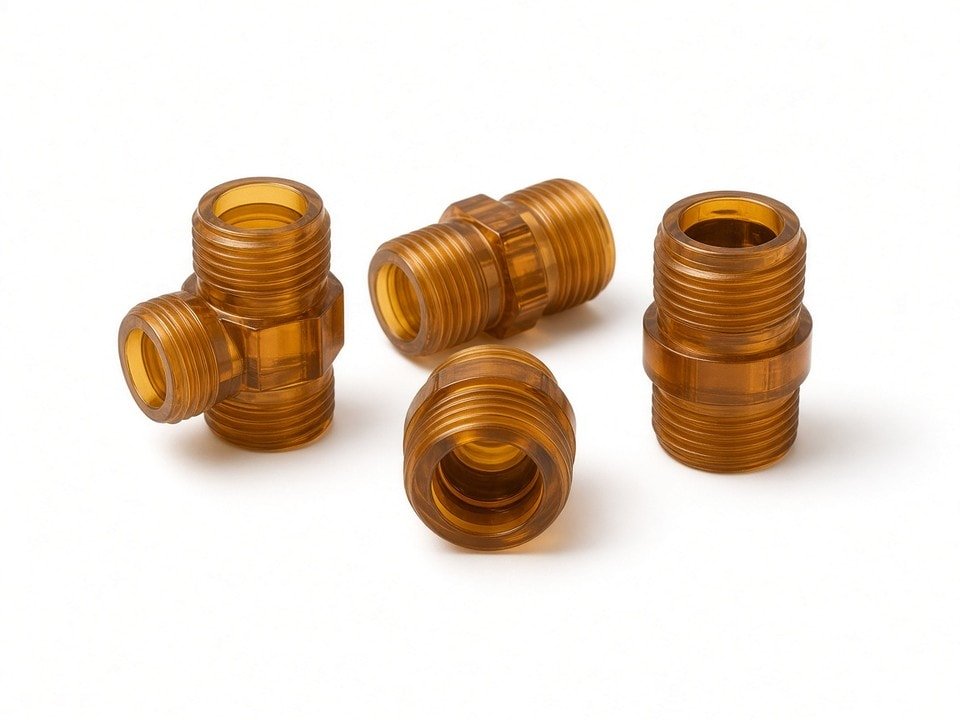
Material and application review
We consider material grade, stock condition, working temperature, chemical contact, transparency and functional tolerances before recommending a process.
~185 °C
Approximate glass transition temperature of PSU; confirm grade-specific data.
CNC milling, turning & turn-mill
Processes selected to suit the part geometry and setup requirements.
Drawing-led inspection
We match measurement and reporting to the characteristics you specify.
Material fit
Where PSU fits—and where it may not
Common PSU grades can suit warm-running components and repeated cleaning or sterilization cycles. Grade-specific continuous-use ratings are well above those of standard engineering plastics such as POM, PA or PC, but the exact selection depends on the application.
Often considered for
- Housings, fixtures and insulating supports
- Valve components and fluid-handling bodies
- Instrument parts and inspection covers
- Parts exposed to elevated temperatures or repeated thermal cycles
Check carefully for
- Aggressive organic solvents, ketones, or chlorinated and aromatic hydrocarbons
- Loaded parts exposed to fluids that may cause crazing or stress cracking
- Sliding contact where wear resistance is the main requirement
If the application points elsewhere, we can discuss alternatives such as PEEK, PPSU or filled grades before you commit to a drawing.
Material selection
The grade and supply condition shape the machining plan
PSU is commonly supplied as extruded rod, sheet or cast blocks. Extruded stock can contain internal stress that shifts as material is removed; cast or annealed stock tends to be more stable for tight-tolerance work. We review the material before cutting rather than assume that all PSU behaves alike.
Exact resin grade and maker
We check the manufacturer and whether the grade is filled or modified.
Stock form and condition
Rod diameter, sheet thickness or near-net blank, plus whether the material is annealed.
Colour and transparency
Natural and tinted grades can differ in appearance and finishing behavior.
Required material data
Share any published datasheet values or performance requirements the part must meet.
If your grade is not specified, we will ask rather than assume a general PSU. Grades differ in heat deflection, chemical resistance and certification status, all of which can affect the finished part.
Process control
Machining amorphous PSU with heat and stress in mind
PSU can be prone to heat build-up, edge melting and residual stress. We plan cutting conditions and workholding to help manage those risks, with sharp tooling and appropriate rake geometry, moderate cutting speeds, sufficient feed to avoid rubbing, and air or controlled coolant where suitable.
-
01
Review the geometry and stock
We consider material condition, wall thickness, slender features and the way the component will be supported.
-
02
Plan roughing and finishing
For tight dimensions, we may leave machining allowance, relax or anneal the part as the grade and geometry require, then finish-machine after the material has settled.
-
03
Limit clamping and setup variation
We adjust fixture support and clamping force for thin walls or slender parts. Turning and milling in one setup can reduce re-clamping and help maintain concentricity and feature position.
Application details
Temperature, chemistry and tolerances are connected
PSU dimensions can change with temperature, moisture and residual stress. Our machining centers and lathes are listed with precision capability of ±0.01 mm for machined metal and general CNC work; that figure is not a blanket tolerance promise for plastic parts. For PSU, achievable tolerance depends on geometry, wall thickness, feature size, material condition and how the part is measured and used.
Functional dimensions
Mark functional and reference dimensions on the drawing. Tell us the measurement temperature and service temperature; a fit that works at 20 °C may not work at 120 °C.
Chemical contact
PSU resists many acids, alkalis, aqueous cleaning agents and hot water, but some solvents, fuels or lubricants can cause swelling, crazing or cracking. We need the specific media, concentration, temperature and contact duration.
Stress and design details
Press fits, snap features and bolted clamping can contribute to crazing when residual stress meets an aggressive fluid. Generous radii, fewer sharp internal corners and stress relief where needed can reduce risk.
We do not confirm chemical suitability from general assumptions. If the environment is uncertain, we recommend compatibility testing on a sample before the production drawing is released.
Appearance requirements
Transparency and surface finish
Some PSU sight windows, inspection components and instrument covers need optical clarity. Machined transparency depends on surface finish, tool marks and stress. We can produce smooth turned and milled surfaces and measure roughness with our surface roughness tester, but machining alone does not create optical-grade polish.
If you need optical-grade polishing, flame polishing or solvent vapour polishing, state it on the drawing. We will assess it as a separate operation with its own risk review.
Regulated applications
Medical and food-contact components
Tell us early if a part will contact food, beverages, pharmaceutical products or body fluids, or be used in a medical device. Compliance depends on the specific resin grade, its supporting documents and how the finished part is cleaned and sterilized.
We need the exact grade name and manufacturer and will request relevant declarations or test certificates before quoting. We operate under ISO 13485 and ISO 9001 quality management systems, subject to valid certification scope, and can support traceability and inspection records to the extent the material documentation allows.
Quality verification
Inspection matched to your drawing
We plan PSU inspections around the specified features and check dimensions after parts have reached stable conditions. Where temperature affects measurement, we control it as far as our environment allows. Inspection reports can be provided for the characteristics you identify.
Our quality management systems are certified to ISO 9001, ISO 13485, AS9100D, ISO 14001 and IATF 16949, subject to valid certification scope.
Inspection equipment includes
- Coordinate measuring machine for 3D and geometric checks
- Optical 2D measuring systems for profiles and hole positions
- Height and concentricity measuring instruments
- Surface roughness tester
- Calipers, micrometers, gauge blocks and pin gauges
- Thread gauges from M1.0 to M16
Prepare your RFQ
What to send with your PSU enquiry
Early-stage information does not need to be complete. Send what you have and we will explain what we need to confirm.
- 1. Drawing or 3D model
Mark critical dimensions and tolerances.
- 2. Material grade
Include manufacturer, or share performance needs if the grade is open.
- 3. Quantity
Include prototype quantity and expected annual or repeat volume.
- 4. Working environment
Service temperature range, contact media and cleaning or sterilization method.
- 5. Surface and appearance
Include finish requirements and whether transparency is needed.
- 6. Compliance requirements
Specify medical or food-contact use and relevant regulatory references.
- 7. Delivery and documentation
Tell us your delivery expectations and inspection or record requirements.
Common questions
Before you release the drawing
These details help us assess whether PSU is a good fit and how to machine it reliably.
Request a PSU machining quote
Share the part, material and working environment
Send us your drawing, material grade, quantity and working conditions. We will review the machining approach and reply with questions or a quotation. We support prototype development, first-article runs and repeat production, and will tell you plainly whether PSU appears suitable for your application.
For the most useful review, include temperature range, chemical contact, transparency needs, critical tolerances and any compliance documents or inspection requirements.