Custom plastic components · PET
PET CNC Machining for Custom Plastic Components
We machine custom components from PET when the part design, material grade, and application are suitable for CNC production. We first review the specific PET grade and stock form, then assess geometry, tolerances, quantity, and service environment.
Share your drawings and requirements with YJCNC. We’ll review critical dimensions, hole and slot features, and assembly interfaces before recommending a machining approach.
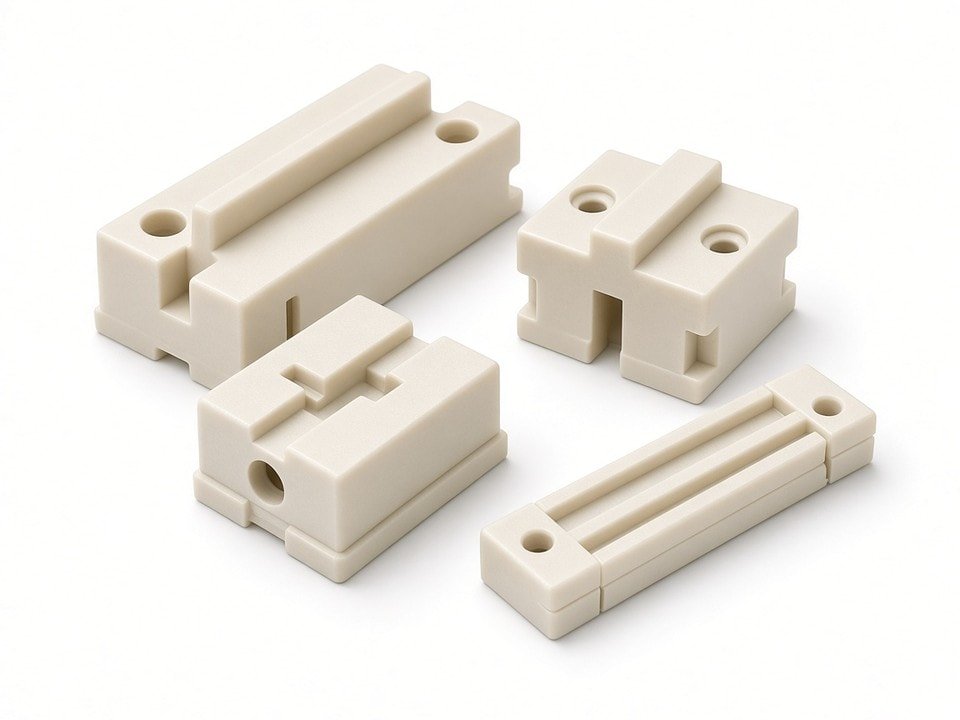
Material review
Start with the PET grade and application
“PET” alone may not identify the material well enough for production. Different grades and supply forms can have different mechanical properties and machining behavior, affecting part dimensions, wear performance, and fit.
We ask you to specify the material grade or provide the relevant material standard and supplier documentation. We also review how the part will be used: temperature, contact with other components, loads, and chemical exposure can all inform whether the proposed material and design are appropriate.
Food-contact or medical applications
Tell us at the RFQ stage if the part is intended for food contact or medical use. We must confirm the exact PET grade and review applicable regulatory documents. A general material description or manufacturing certification alone does not establish product compliance.
Process options
PET machining shaped around your part
PET CNC machining can produce custom profiles, bores, slots, threaded features, and mating surfaces. We assess the geometry and the dimensions that matter to the part’s function before selecting a process.
Milling
May suit housings, plates, brackets, and parts with multiple faces or pockets.
Turning
May suit rotational components such as sleeves, bushings, and shafts.
Turn-mill
May be considered when a component combines turned forms with milled features.
Swiss-type machining
May suit small or slender parts, subject to material and design review.
Plan for material state, holes, slots, and fit
For plastic components, tool engagement, clamping, and heat during cutting can influence the finished part. We review thin walls, close-fitting bores, narrow slots, and mating faces so the proposed process accounts for the component’s geometry and dimensional requirements.
Manufacturing resources
Equipment options for custom PET parts
Our equipment range gives us options to assess for different part geometries and order requirements. Listed machine precision is not a guarantee of achievable tolerance on a specific PET component.
| Process or resource | Equipment listed | Quantity | Listed precision | Typical application |
|---|---|---|---|---|
| CNC milling | 3-axis machining centers | 25 | ±0.01 mm | Plates, housings, brackets |
| CNC milling | 4-axis machining center | 1 | ±0.01 mm | Multi-sided components |
| CNC milling | 5-axis CNC machines | 8 | ±0.01 mm | Complex profiles and multi-sided parts |
| CNC turning | CNC lathes | 43 | ±0.01 mm | Sleeves, bushings, turned components |
| Turn-mill machining | CNC turn-mill machines | 15 | ±0.01 mm | Parts combining turned and milled features |
| Swiss-type machining | 5-axis and 6-axis Swiss-type lathes | 6 | ±0.01 mm | Small or slender components |
| Dimensional inspection | CMM, optical systems, gauges | Multiple | Application-dependent | Drawing-based dimensional checks |
Achievable tolerance depends on the material, part size, geometry, machining sequence, and inspection requirements. We support prototype development, repeat orders, and production runs subject to project requirements; we’ll assess process and inspection suitability during quotation.
Quality and assembly
Inspection focused on fit and function
A PET part can be dimensionally correct in general form yet still cause assembly problems if a critical bore, slot, or mating face is out of specification. We use drawing-defined inspection requirements to focus checks on features that affect function.
Our inspection resources include a coordinate measuring machine, optical measuring systems, height measuring instruments, micrometers, pin gauges, and other dimensional gauges. Depending on the drawing, we can review hole position, dimensions, profiles, and fit-related features. Identify critical-to-function dimensions and any required inspection records in your RFQ.
What we review before quoting
- 01
Material: Exact PET grade, specification, supplier, and stock form.
- 02
Geometry: Part dimensions, thin sections, holes, slots, threads, and machined faces.
- 03
Tolerances: General tolerances and tighter requirements for functional or mating features.
- 04
Assembly: Fits, clearances, alignment needs, and interfacing components.
- 05
Application: Operating conditions, loads, wear expectations, and food-contact or medical use.
- 06
Order and quality: Quantity, prototype or production status, repeat-order needs, inspection priorities, and required documentation.
If a drawing tolerance may be difficult to hold in the proposed material or geometry, we can discuss the feature and review possible design or process adjustments before production.
Project suitability
Is PET CNC machining suitable for your project?
PET may be a candidate when you need a custom plastic component with defined dimensional and mechanical requirements. Suitability depends on the specific grade, stock form, part geometry, and operating environment—not on the material name alone.
CNC milling or turning may be appropriate for prototypes, design validation, and production parts when the required features can be machined and inspected. For repeat orders, an agreed material specification and drawing revision help keep sourcing and inspection requirements clear. We review each project rather than assume that a process or tolerance from one component applies to another.
Send us your requirementsCommon questions
PET machining considerations
Request a quotation
Let’s review your PET component
Send us your material specification, drawing, quantity, and application requirements. We’ll review the PET grade, stock form, critical dimensions, and proposed machining process before preparing a quotation. Include any food-contact or medical-use requirements and the supporting documents you need reviewed.
Share your project details
Include the material grade, drawings, required quantity, and application details so we can assess the part and its fit requirements.