CNC Machining Service
FR4 Fiberglass Laminate Machining
We review custom FR4 fiberglass laminate parts for electronic equipment manufacturers that need electrical insulation plates, mounting panels, supports, and other drawing-specific components. Send us the part drawing, material specification, and intended application, and we will assess geometry, inspection requirements, and machining feasibility before we quote.
At YJCNC, we apply CNC milling and other precision processes to custom components. FR4 is abrasive and fiber-reinforced, so we confirm its grade, thickness, geometry, and handling requirements before deciding whether a project fits our process capabilities.
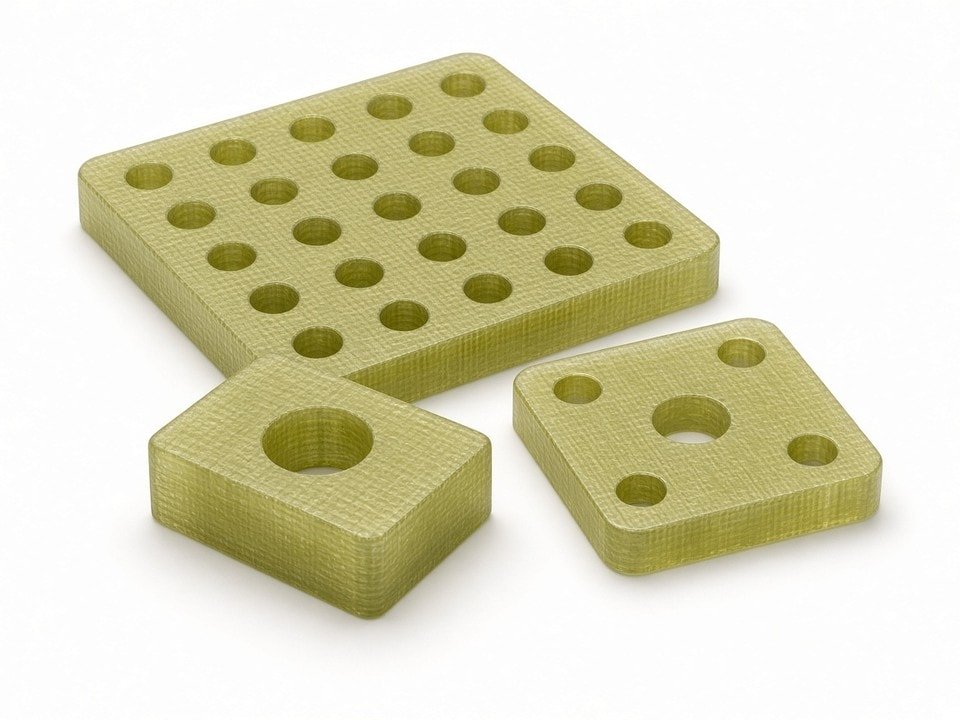
Start with the FR4 grade and application
“FR4” alone may not identify the exact laminate required for a part. Grade, thickness, construction, and electrical or flame-related requirements can vary. We need the material specification and intended use to evaluate whether the component can be machined and inspected as drawn.
If your project specifies a flame-retardant classification, dielectric property, or other electrical safety requirement, please provide the applicable material grade and standard. We do not infer compliance from the FR4 name alone. Any such requirement must be confirmed against the material specification and project documentation.
Machining considerations for fiberglass laminate
FR4 contains glass reinforcement, which affects cutting and drilling behavior. Tool engagement can influence hole quality, edge condition, and the risk of fiber breakout or delamination. Thin sections, closely spaced holes, narrow webs, and features near an edge often need particular attention during drawing review.
We plan each job around panel thickness, support during cutting, feature sequence, and required dimensional checks, measured against the part geometry and the material information you supply.
Milling for plates, panels, and supports
CNC milling suits flat or block-style FR4 components with profiles, pockets, slots, and mounting features. Our equipment includes 3-axis machining centers, a 4-axis center, and 5-axis CNC machines. The right setup depends on your part design and is confirmed during project review.
Typical drawing features we evaluate
- External profiles and cutouts
- Mounting holes and hole patterns
- Slots, notches, and access features
- Counterbores or other specified machined details
- Multiple faces or features requiring coordinated positioning
Route selection
We review overall size, thickness, clamping needs, and feature access before recommending a machining route for your part.
Manufacturability input
Very thin walls, small edge distances, or fragile tabs can be discussed early, so we can suggest adjustments that improve manufacturability.
Equipment matched to geometry
Flat parts and simple profiles can be planned on 3-axis work, while parts needing additional access or positioning may be assessed for 4-axis or 5-axis setups.
Hole position, edge quality, and delamination risk
Hole location and finished edge condition affect assembly alignment and electrical clearances. We assess critical dimensions and geometric relationships from the drawing, including hole-to-edge distances, position requirements, and fit or fastening details.
If your drawing calls for a particular edge condition or allowable damage limit, include it explicitly. Without stated acceptance criteria, we will clarify inspection expectations before production rather than assume an undocumented standard.
Thickness, tolerances, and inspection planning
Our inspection resources include CMM equipment, optical measuring systems, height measuring instruments, calipers, and other dimensional gauges. These tools support drawing-based verification of dimensions and profiles.
We agree on the inspection method and reporting requirements based on the features that matter most for your assembly and application.
Inspection tools
- Coordinate measurement
- CMM equipment for position and profile checks
- Optical measurement
- Optical systems for feature and edge verification
- Height measurement
- Height instruments for thickness and step checks
- Manual gauging
- Calipers and other dimensional gauges
Dust control and part handling
Machining fiberglass laminate produces dust and debris that require appropriate control. Before accepting a project, we review the material information and the handling expectations and site requirements that apply.
Dust and cleanup
Dust-control arrangements, cleanup, and personal protective measures are set for the specific work and follow relevant safety documentation, including the material supplier's SDS.
Customer handling requirements
Tell us about packaging, cleanliness, segregation, or handling needs. We confirm what can be supported before production begins, rather than assuming requirements for contamination-sensitive or controlled environments.
Which FR4 projects are a good fit?
We assess projects for electronic equipment manufacturers that need custom insulating or structural laminate components. Repeat orders can be reviewed against the agreed drawing, material specification, inspection plan, and order requirements.
For a new design, early discussion of thickness, hole placement, edge quality, and documentation helps identify concerns before release to production.
- Electrical insulation plates and barriers
- Mounting panels and equipment supports
- Custom plates with drilled or slotted features
- Replacement or repeat components made to customer drawings
- Prototype parts for design evaluation, subject to project feasibility
What to include in your RFQ
For a useful feasibility review and quotation, please send the following. If any information is still being finalized, tell us what is open and we will identify what is needed to evaluate the part.
-
1
Drawing or CAD file
Dimensioned, with tolerances and critical features marked.
-
2
Material specification
FR4 grade, thickness, and construction details.
-
3
Applicable standard
Flame-retardant, dielectric, or other performance requirements, where relevant.
-
4
Quantity and delivery
Required quantity, target order pattern, and delivery location.
-
5
Inspection and handling
Documentation, packaging, and handling requirements.
-
6
Edge and surface criteria
Defined limits for edge quality, delamination, or surface condition.
Request an FR4 machining review
Send your drawing, material specification, and required quantity to info@yjcncmachining.com. We will review the part requirements and follow up on feasibility, inspection expectations, and anything needed to prepare a quotation.
Company address
Yabian Community, Shajing Street, Baoan District, Shenzhen, China