C110 Electrolytic Tough-Pitch Copper
C110 Electrolytic Tough-Pitch Copper CNC Machining
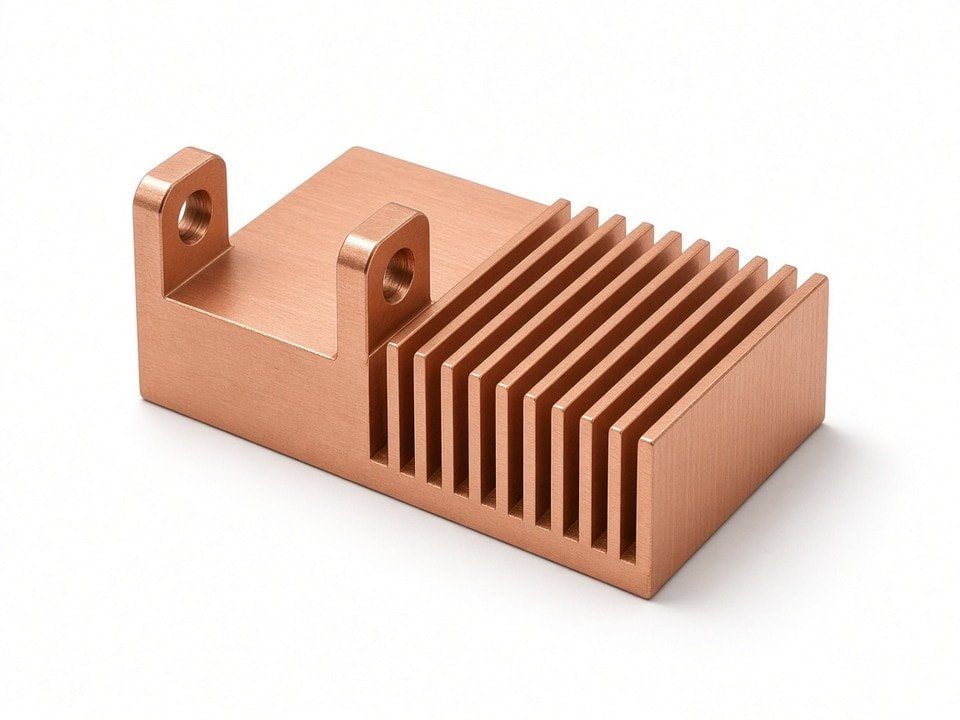
C110 is the copper grade we machine most often for busbars, grounding components, heat-transfer parts and conductive contacts. It conducts well, but it is soft. It deforms, smears and tears under cutting loads that would leave brass or steel clean, so we plan every job around those properties.
Before I quote a C110 part, my team reviews the temper, the function of the part and its geometry together. Each of these changes the setup, the tooling and the inspection plan.
What C110 Requires from the Process
C110 is electrolytic tough-pitch copper with a minimum electrical conductivity of 100% IACS in the annealed condition. It contains a small amount of residual oxygen. For most machined parts this has little effect, but I want to flag one case early: if a part will be brazed or heated in a hydrogen-containing atmosphere, that oxygen can cause embrittlement. If your assembly involves this, tell us so we can confirm whether C110 or an oxygen-free grade is the better fit.
Annealed
O60 Annealed Stock
Annealed material is easy to deform and tends to produce long, stringy chips. We adjust chip control and support strategy to keep thin sections stable during cutting.
Cold-Worked
H01, H02 and H04 Tempers
Cold-worked tempers are stiffer and hold dimensions better on thin sections. They carry residual stress from drawing or rolling, which can move a part after the first roughing pass. That is why I ask for the temper on every RFQ. A drawing that specifies only "copper" leaves the most important variable open.
Our Equipment for Copper Turning and Milling
We machine C110 on the same equipment we use for other non-ferrous and steel parts, selected by part size and feature type. The table below lists the processes we use most often for copper components.
43
CNC lathes
30
Automatic lathes
25
3-axis machining centers
9
4-axis and 5-axis machines
| Process | Equipment Available | Quantity | Listed Precision | Typical Copper Parts |
|---|---|---|---|---|
| CNC Turning | CNC Lathes | 43 | ±0.01 mm | Busbar spacers, bushings, shafts, heat sinks |
| Automatic Turning | Automatic Lathes | 30 | ±0.02 mm | Pins, small contacts, turned terminals |
| Turn-Mill Machining | CNC Turn-Mill Machines | 15 | ±0.01 mm | Parts with turned and milled features in one setup |
| Swiss-Type Machining | Swiss-Type Lathes (5-axis, 6-axis, other) | 10 | ±0.01 mm | Slender pins, small-diameter connectors |
| CNC Milling | 3-Axis Machining Centers | 25 | ±0.01 mm | Brackets, mounting plates, bus clamps |
| CNC Milling | 4-Axis and 5-Axis Machines | 9 | ±0.01 mm | Multi-face thermal blocks and complex profiles |
| CNC Turning | Gang-Type CNC Lathes | 7 | ±0.01 mm | Short runs of small conductive parts |
Cutting Strategy for Gummy Copper
Copper is gummy at the cutting edge. Dull tools rub, build up material and pull fibers out of the surface. We select sharp tools with positive rake geometry, match speeds and feeds to the temper and wall thickness, and manage chip evacuation so chips do not recut the surface.
Coolant and Small-Part Control
For turning, we maintain coolant or air-blast delivery at the cutting zone. On Swiss-type work with small parts, we keep guide bushing contact and tool run-out under close watch, because copper resists deflection far less than steel.
Controlling Burrs, Surface Damage and Distortion
Soft copper shows problems that harder metals hide. Select a topic below to see how we manage it on C110 parts.
Burrs are the most common complaint on copper parts. A burr on a current-carrying edge can cause hot spots, interfere with mating surfaces or cut into insulation during assembly. We reduce burr formation at the source with sharp tools and exit-controlled feeds on through-holes and slots.
Where the drawing specifies edge condition, we add a dedicated edge-break or deburring operation and confirm it on the first article. We do not rely on tumbling alone for features with tight edge requirements, because tumbling can round dimensions that must hold.
Inspection for Conductive and Thermal Components
I verify copper parts against the drawing with the same inspection resources we use for other precision work. Measurement is matched to the feature, so the right instrument checks each dimension.
3D and Profile Measurement
A coordinate measuring machine checks 3D geometry and position. 2D optical systems measure profiles, hole locations and small features.
Routine and Finish Checks
Micrometers, pin gauges, height gauges and calipers cover routine dimensions. Our surface roughness tester checks finish.
Shafts and Bushings
Concentricity measurement is available for shafts and bushings. Our Rockwell hardness tester supports material verification.
Conductivity Certification
Electrical conductivity is a material property we cannot measure in-house. If your specification requires conductivity or hardness certification, tell us at the RFQ stage. We will confirm whether the test can be done in our facility or needs an accredited external lab, and include that cost and lead time in the quote.
Is C110 the Right Material for Your Part?
C110 is a strong choice when electrical or thermal performance is the main requirement. It is less suited to parts that need high machinability at low cost or structural strength. Use the table below as a starting point for our discussion during quotation review.
| Your Requirement | C110 Fit | Points to Discuss |
|---|---|---|
| High electrical or thermal conductivity | Strong fit | Temper and surface condition for contact areas |
| Brazing or heating in hydrogen atmosphere | Caution | Oxygen content may cause embrittlement; oxygen-free grades may be better |
| High-volume, low-cost turned parts | Moderate fit | Free-machining copper alloys may reduce cycle time |
| Thin-wall or long-slender parts | Moderate fit | Temper choice, support strategy and inspection sequence |
| Tight flatness or positional tolerance | Good fit with planning | Stress relief and staged machining |
| Corrosion exposure in marine or chemical settings | Depends on environment | Surface treatment or alternative alloy |
If C110 is not the best fit, I will tell you during review rather than quote a part that will struggle to meet the drawing.
Send Your RFQ for C110 Copper Parts
To quote C110 parts accurately, I need the following information. The sooner I see the temper and the function of the part, the more accurate the quotation will be.
- Material standard and grade, such as UNS C11000, ASTM B152 or EN CW004A
- Temper, or a note that any temper is acceptable
- Drawing with dimensions, tolerances, surface finish requirements and edge conditions
- Quantities for prototype and production releases, and expected annual volume
- Conductivity, hardness or other material certification requirements
- Any plating, coating, cleaning or packaging steps after machining
- Inspection report requirements, such as first-article or dimensional reports
Request a C110 Quotation
Share your drawings, material standard, temper, quantities and any conductivity or thermal requirements. I will review each RFQ for material suitability, machining method and inspection plan, then reply with a quotation and any recommendations that affect cost or performance.
AddressYabian Community, Shajing Street, Baoan District, Shenzhen, China