Precision titanium machining for engineering and procurement teams
Grade 5 Titanium Ti-6Al-4V CNC Machining
We machine custom components to customer drawings and specifications, including parts designed for Grade 5 titanium Ti-6Al-4V. The material callout is only one part of the job. Before production, we agree on material condition, geometry, critical tolerances, inspection records, and traceability.
Send us your drawing and complete material specification. We will assess suitable machining processes, clarify requirements that affect inspection or documentation, and confirm feasibility before we quote.
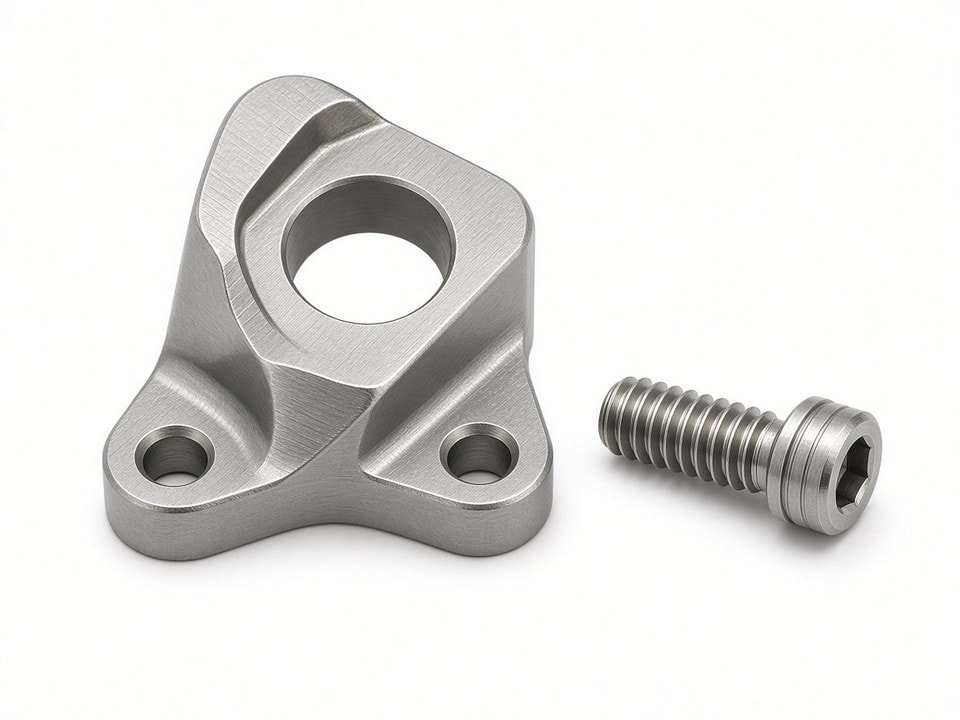
Start with a complete material specification
“Grade 5 titanium” is not a complete purchasing specification by itself. Before we machine, we need the required alloy designation, product form, material condition, applicable standard or specification, and any customer-specific requirements.
Different material conditions and supply specifications can affect machinability and the documentation expected with the order. Please state the required condition and documentation in your inquiry instead of relying on a general Grade 5 or Ti-6Al-4V callout.
If material certification or traceability records are required, we will review the requested documents and confirm what can be provided and retained for your project. Material availability and document scope must be confirmed before we accept an order.
Machining considerations for Ti-6Al-4V
Ti-6Al-4V requires a controlled approach to cutting. Its low thermal conductivity can concentrate heat near the cutting edge, while tool wear, chip evacuation, workholding, and part geometry all affect the result. Rubbing, interrupted cuts, slender features, and poor access make process planning more demanding.
We review the part design and operation sequence to determine suitable machining methods and inspection points. Cutting conditions and tooling are selected for the specific material condition, feature geometry, and production requirements, not assumed from the alloy name alone. Our goal is to manage heat and tool wear while maintaining the required dimensions and surface characteristics.
CNC capacity for custom titanium components
Our equipment inventory includes CNC milling, turning, turn-mill, and Swiss-type machining resources. We evaluate these options against each part geometry and order requirement.
34
CNC milling
25 listed 3-axis machining centers, one 4-axis center, and eight listed 5-axis machines for prismatic, multi-sided, and complex-profile components.
43
CNC turning
CNC lathes for shafts, sleeves, bushings, and other rotational parts.
15
Turn-mill machining
Machines for components that combine turned features with milled flats, slots, holes, or other secondary features.
10
Swiss-type machining
Listed Swiss-type lathes, including 5-axis and 6-axis machines, for small or slender components subject to project review.
Supporting equipment
Automatic lathes, gang-type lathes, screw machines, conventional milling machines, and surface grinders for suitable applications.
Equipment selection depends on part envelope, feature access, tolerance scheme, quantity, and material requirements. Listed machine precision is not a guaranteed tolerance for a finished part. We review each drawing to confirm achievable dimensions and inspection methods.
Process selection follows part geometry
A suitable route depends on how the component is designed and where its critical features are located. We review the drawing to decide whether the part is best made by milling, turning, turn-mill machining, or Swiss-type machining.
We confirm the process after reviewing the actual geometry. A design change that improves tool access, reduces unnecessary tight tolerances, or clarifies datums may also simplify production and inspection.
Items to review: datum strategy, access, setup count, and positional tolerances.
Items to review: runout, concentricity, surface finish, and feature relationships.
Items to review: feature access, operation sequence, and datum transfer.
Items to review: part length, support, tool access, and critical dimensions.
Control priorities: heat, tool wear, and geometry
For titanium work, the machining plan must account for how each feature is cut, not only the overall part shape. Cutting heat and tool wear can affect dimensional consistency, especially across longer runs or when features need multiple setups. Thin walls, deep pockets, narrow slots, and long unsupported sections can be sensitive to cutting forces and workholding.
-
Material condition and stock form
Confirmed to match the drawing and purchase specification.
-
Tool access and chip evacuation
Reviewed for deep, narrow, or interrupted features.
-
Workholding and setup sequence
Planned to support critical datums and limit part movement.
-
Tolerance allocation
Functional dimensions are identified rather than applying tight limits indiscriminately.
-
Inspection access
Confirmed for internal, positional, concentricity, or profile requirements. If a feature or tolerance appears difficult to verify or manufacture as drawn, we will raise it during review rather than silently substituting a process or acceptance criterion.
Inspection and documentation are part of the quote
Inspection requirements should be clear before production begins. Our inspection resources include a coordinate measuring machine, optical measuring systems, height instruments, a concentricity instrument, a surface roughness tester, precision gauges, and other dimensional inspection equipment. We select methods according to the features, tolerances, and records specified for the project.
Please identify any required inspection report, sampling plan, material documentation, special process records, or customer-specific forms in your RFQ. We will confirm which requirements fall within the agreed scope and how each will be addressed.
Quality systems and regulated applications
Our quality management systems are certified to ISO 9001, ISO 13485, AS9100D, ISO 14001, and IATF 16949. For medical or aerospace applications, we verify the applicable certification scope, customer qualification status, material documentation, and project-specific requirements before accepting an order.
A Grade 5 or Ti-6Al-4V material designation is not itself a product certification or evidence of regulatory approval.
Projects we can review
We consider titanium machining inquiries for custom components such as shafts, bushings, sleeves, connectors, mounting features, housings, and other drawing-defined parts. Our process range can support prototype development, repeat orders, and production runs, subject to part feasibility, documentation, and project requirements.
Drawing-controlled parts
CNC-machined components made to controlled drawings and material specifications.
Process option review
Evaluation of milling, turning, turn-mill, and Swiss-type options for your geometry.
Critical-feature inspection
Dimensional inspection planned around defined critical features.
Repeat production
Agreed requirements for material records and inspection documentation across orders.
Medical, aerospace, and regulated supply chains
Tell us the intended application and supplier qualification requirements at inquiry stage. We will confirm the relevant scope rather than assume that a material grade or general certification covers the finished part.
Submit a complete RFQ for review
To help us assess Grade 5 titanium Ti-6Al-4V machining accurately, include the following with your inquiry.
-
1
Current drawing or 3D model
Include revision level and units.
-
2
Complete material specification
Alloy designation, condition, applicable standard, and any customer-specific requirements.
-
3
Annual and order quantities
Plus prototype or production timing.
-
4
Critical tolerances and datums
Surface finish, geometric controls, and inspection expectations.
-
5
Required material and quality documentation
Certificates, inspection reports, traceability records, or customer forms.
-
6
Application and qualification details
Required if the part is for medical, aerospace, or another controlled supply chain.
Send your package for manufacturing review
Email your drawing, complete material specification, quantities, critical tolerances, and documentation requirements. We will review the information, clarify open technical points, and respond with quotation details or the questions needed to establish a reliable scope.
- info@yjcncmachining.com
- Phone
- Address
- YJCNC
Yabian Community, Shajing Street, Baoan District, Shenzhen, China