CNC machining · Composite project review
Carbon-Fiber-Reinforced Polymer Machining
We review drawings for custom carbon-fiber-reinforced polymer (CFRP) components and assess whether our CNC milling capabilities, inspection resources, and project controls fit your part.
Share the material structure, drawing, quantity, and application requirements. We’ll review the project details before confirming whether we can quote the work.
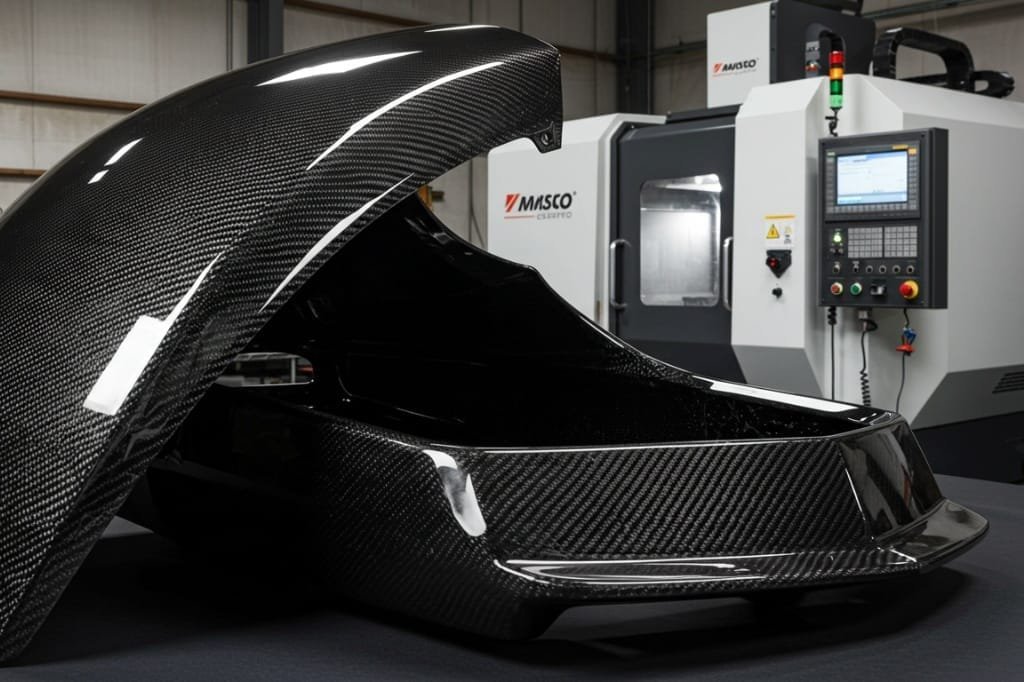
The material and layup matter
CFRP machining feasibility depends on the composite construction, fiber orientation, part geometry, edge requirements, and safe-processing needs.
01 · Identify the material
Start with the material form
“CFRP” describes different material forms that do not necessarily machine the same way. We first establish what the component is made from and how its fibers are arranged.
If the designation is unclear, send the supplier data sheet or material specification with your drawing.
CFRP laminate plate or sheet
Stacked plies often have specified fiber orientations. Machined edges and holes can expose ply interfaces, so we review the layup and thickness.
Molded CFRP parts
We need the material and process details, along with the features that still require machining and the available machining allowance.
Other composite forms
Tubes, pultruded profiles, and parts with local or changing fiber directions may need a different feasibility review than flat laminate stock.
Carbon-fiber-reinforced thermoplastic
This is a distinct material family, not interchangeable with CFRP laminate or molded parts made with other matrix systems. Please identify it explicitly in your RFQ.
02 · Drawing and process fit
What we assess before quoting
We review the part geometry together with the composite structure. A drawing alone may not establish whether a feature is suitable for machining.
Material construction and fibers
Matrix type, laminate or molded form, ply schedule, fiber architecture, and orientation relative to holes, edges, and pockets.
Thickness, support, and access
Section thickness, unsupported areas, clamping access, and the potential for distortion or local damage.
Holes, edges, and tolerances
Hole diameters and locations, edge distances, countersinks, cutouts, critical dimensions, datums, and assembly-related geometry.
Production context
Quantity, repeat-order expectations, delivery requirements, traceability, and the inspection records you need.
Safe-processing requirements
We review material-specific handling and dust-control requirements before production. If needed, we may request a material specification, representative sample, or additional engineering details before confirming feasibility.
03 · Risks we review
Protecting edges, holes, and ply interfaces
CFRP is anisotropic: its response to machining depends on fiber orientation and material construction. A feature that is straightforward in one layup can present a different risk in another.
Delamination
Ply interfaces around holes, machined edges, and thin sections may need particular attention.
Fiber pull-out
Rough or damaged edges can affect component fit, appearance, or performance requirements.
Hole-edge damage
Damage around a hole may affect fastener seating or assembly and should have agreed acceptance limits.
We review the material and feature geometry to identify these risks before a production plan is accepted. If the drawing does not define an acceptable edge condition or damage limit, we ask you to clarify rather than assume a standard.
04 · Equipment and inspection
Capabilities reviewed against your part
Our listed equipment includes 25 three-axis CNC machining centers, one four-axis machining center, and eight 5-axis CNC machines, with stated equipment precision of ±0.01 mm.
This inventory supports a range of component geometries, but it does not establish that every CFRP material or feature is suitable. We compare the geometry and tolerances with available equipment and the material’s machining requirements, then confirm the proposed process, limitations, and inspection approach during project review.
25
Three-axis CNC machining centers
1 + 8
Four-axis center and 5-axis CNC machines
±0.01 mm
Stated equipment precision
3 systems
ISO 9001, ISO 13485, AS9100D, ISO 14001, and IATF 16949; applicability depends on scope and project requirements
Inspection resources
Our equipment includes a coordinate measuring machine, five optical measuring systems, height measurement instruments, gauges, and dimensional inspection tools. We use these resources for drawing-based verification where suitable for the part and measurement method.
Composite inspection may require agreed methods and acceptance criteria beyond dimensional checks. We do not infer that internal defects or structural integrity have been verified unless the inspection method and scope are defined.
05 · Define acceptance
Tell us what controls part acceptance
CFRP drawings can need more detail at machined features than a general dimensional callout provides. We can identify open questions during drawing review, but acceptance limits should be agreed before production.
- Hole diameter, position, and fit requirements
- Edge limits for fraying, chipping, or exposed plies
- Surface finish and visible-face requirements
- Countersink or counterbore geometry
- Areas where fiber exposure is restricted
- Features tied to assembly or structural performance
Processing feasibility
Dust control and safe processing
Machining carbon-fiber composites can generate fine dust. We treat safe handling and suitable dust-control arrangements as part of project feasibility, not an afterthought.
We review material safety information and your processing requirements before confirming the work. Our available information does not specify dedicated composite dust-extraction equipment, so we do not claim a particular system. Include any required controls with your RFQ so we can assess whether they can be met.
Select a route
Machining route depends on the part
- Laminate plates: We review ply orientation, thickness, edge distance, hole requirements, and acceptable edge quality.
- Molded parts: We assess the existing shape, machining allowance, datum access, and risk to the molded structure.
- Small or slender components: We review geometry, rigidity, clamping, and process suitability.
- Tight tolerances or demanding documentation: We compare the requirements with our inspection capability and confirm limits before quotation.
If a requested feature or material is outside a suitable process or inspection route, we will raise that during review rather than imply a confirmed capability.
For engineering and procurement teams
A clear review starts with shared requirements
We work with OEMs, industrial equipment manufacturers, robotics and automation companies, engineering teams, and contract manufacturers that need custom components made to drawings.
CFRP may suit applications that call for a lightweight or high-stiffness composite component, subject to material and process review. Early agreement on material identification, acceptance criteria, inspection records, and safe-processing requirements helps reduce quotation gaps and later changes.
Your RFQ checklist
What to include in your CFRP inquiry
The more clearly the material, acceptance criteria, and application are defined, the more useful our initial review can be.
- Material form and specification: Laminate, molded component, tube, pultruded profile, or another form; include matrix type and supplier data if available.
- Fiber details: Layup, fiber orientation, and ply schedule, where applicable.
- Technical drawing: Dimensions, tolerances, datums, hole details, and edge or surface requirements.
- Quantity: Prototype, initial order, and expected repeat quantities if known.
- Application requirements: Assembly interfaces, operating environment, and relevant structural or cosmetic acceptance criteria.
- Quality and safety: Inspection records, traceability expectations, material safety information, and required dust-control provisions.
- Delivery details: Target schedule and shipping destination.
Common questions
Before you send a drawing
Request a project review
Send us your CFRP project details
Email your drawings and project details to info@yjcncmachining.com. We’ll review the material structure, geometry, quantity, inspection expectations, and processing requirements before confirming whether we can quote the work.
For a direct discussion with YJCNC, contact us at Yabian Community, Shajing Street, Baoan District, Shenzhen, China. We welcome inquiries for CFRP components where the material and project requirements can be clearly defined.
Start your inquiryShare the details that matter
Include the material structure, drawing, quantity, application requirements, and any quality or safe-processing needs.